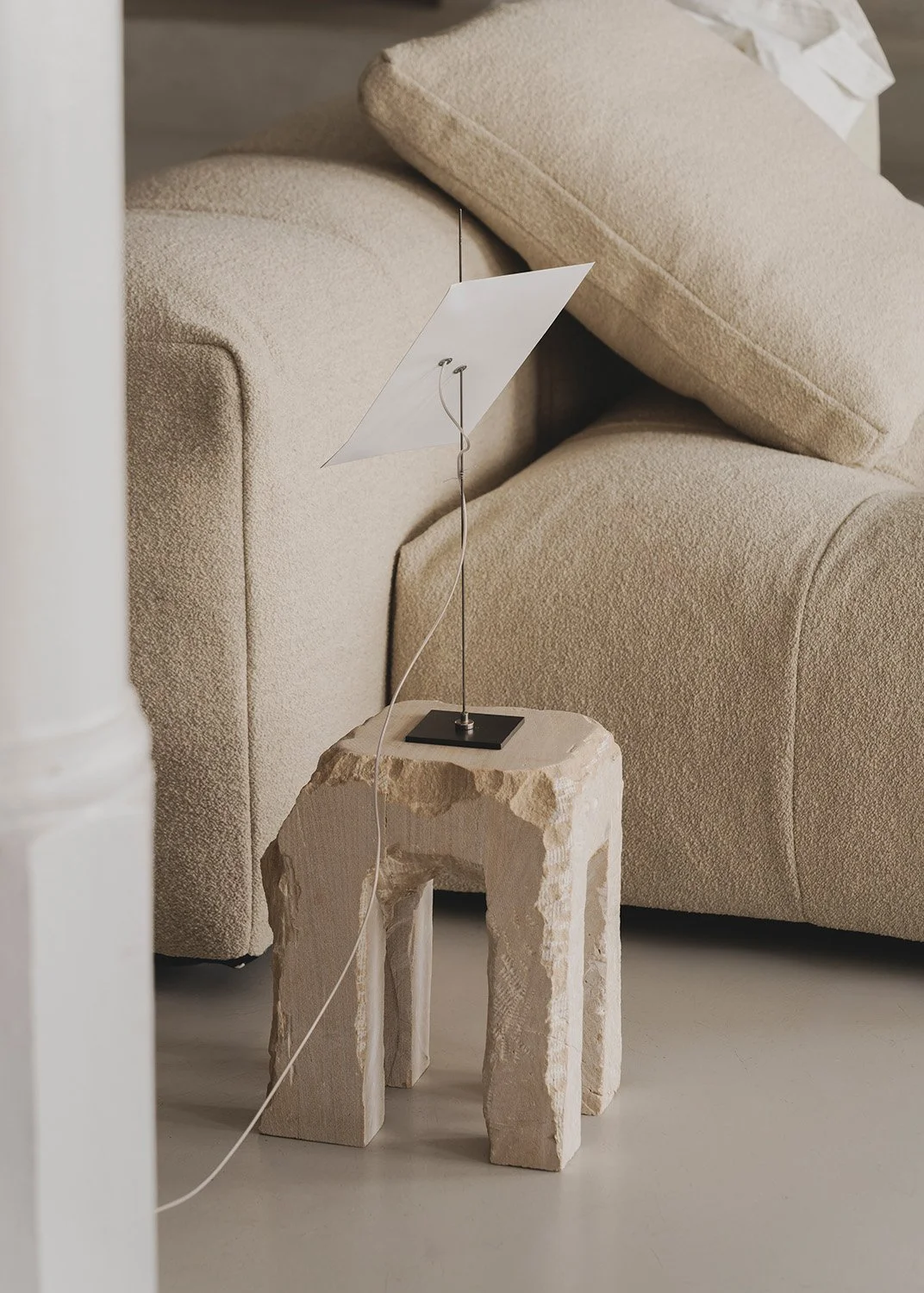
Editorial en vivo por Charlotte Taylor
ORDEN, JUEGO Y CAOS
-
Entrevista a Charlotte Taylor para Openhouse magazine Nº20.
-
Texto deInma Buendia inmabuendia.com
Fotos de Enric Badrinas enricbadrinas.com
Side Gallery side-gallery.com
Charlotte Taylor @charlottetaylr
-
ORDEN, JUEGO Y CAOS
Un inmenso espacio sin apenas paredes, rodeado de ventanas, cuyos suelos y techos poseen un solo color, aparece en escena. Resulta difícil adivinar su uso: ¿es una casa, es una oficina, es una galería o todo ello al mismo tiempo? La mirada va poco a poco distinguiendo los detalles. Hay una mesa vestida para quizá recibir invitados y una cama deshecha con un ordenador portátil sobre ella. Unos pasatiempos sobre un escritorio, una pequeña mesa sobre la que descansa un ajedrez, y varios objetos utilitarios como sillas, ceniceros o copas con gran atractivo escultórico, que bien podrían ser expuestos en un museo.
Se trata de la primera ‘live editorial’ de Openhouse. Una instalación de la mano de Charlotte Taylor que reinterpreta aquello que llamamos hogar en un imponente escenario, Side Gallery. Un artefacto contemporáneo en sus formas pero clásico en su propósito: la conservación y disposición de registros históricos relacionados con el diseño latinoamericano del siglo pasado. La majestuosa obra llevada a cabo por Guillermo Santomá en los 700 metros cuadrados de esta galería de Barcelona tan sólo se reviste de hormigón. Este material sirve para unificar tan vasto espacio en una sola pieza formal y funcional. Un cuerpo de trabajo sobre el que Luis Sendino, comisario y fundador de la galería, alterna tradición y vanguardia en una melancólica aproximación al pasado que invita a soñar con posibles futuros.
En esa suerte de paréntesis temporal se halla la propuesta creativa de Charlotte Taylor. Ajena al ruido estético a su alrededor, su mesa de trabajo es el inagotable archivo de imágenes que la diseñadora cataloga en su mente creando sinergias entre arte y cotidianeidad, entre orden y caos. Orbitar en el mismo espacio que Charlotte es dejarse imbuir por el calmado –que no dócil– carácter que transmite a cada paso. Un talante del que nacen ambientes sofisticados, vivaces y con un gran sentido del humor. Charlotte es la primera artista que, de la mano de talentosos creadores de todas partes del mundo, ha desarrollado la editorial en vivo que inaugura una nueva forma de expresión para Openhouse.


¿Cómo incorporaste tus gustos y preferencias con los de Openhouse y Side Gallery en la ‘live editorial’?
Ya existía una sinergia entre Openhouse, Side Gallery y mi estilo personal, así que el resultado fue más un collage de superposición de algunos de mis gustos más específicos sobre una paleta que siento familiar. Las camas deshechas tipo sudoku y las camisas a rayas son definitivamente una firma mía que aporta un poco de desorden.
¿Qué parte del proyecto disfrutaste más?
Ver a la gente interactuar con el espacio y las piezas. Hubo un grupo de niños que comenzaron a jugar al ajedrez. Ese fue mi momento favorito que alcancé a capturar.
¿Cómo difiere la curaduría de arte en una casa-galería de los espacios de galería tradicionales? ¿Cómo facilita el diseño esta distinción?
El aspecto doméstico del espacio aporta ese elemento personal a la galería y es una invitación a interactuar con el espacio y las piezas de una manera más casual y exploratoria. En diseño, hay una consideración diferente en el movimiento de las personas a través del espacio. La gente se apoya y recuesta en las piezas formando parte del espectáculo en lugar de ser simples visitantes. Se trata de llevar la experiencia de la galería más allá de la perspectiva visual e involucrar los otros sentidos.
¿Cómo consigues crear una imagen homogénea, elegante y desenfadada?
Manteniendo un elemento de juego y caos, permitiendo que las cosas tengan un sentido de movimiento y apertura, y alejando mi práctica de espacios que se perciben como muy elevados pero estáticos.
¿Hay objetos o materiales de diseño específicos que encuentres particularmente efectivos para lograr este equilibrio?
Los objetos contribuyen en gran medida a compensar un espacio, aportar una noción de personalidad y romper una disposición rígida.
¿De qué modo se nutre e inspira tu trabajo de elementos culturales e históricos?
Siempre estoy buscando inspiración en la diversidad de épocas históricas y culturales, y en los diferentes movimientos del mundo del diseño. Trabajo las similitudes y los contrastes fusionando referencias en algo nuevo pero muy arraigado en el pasado.
¿Cómo es la relación del diseño con otras disciplinas artísticas en tu trabajo?
Es muy fluida. Mi proceso pivota en gran medida entre el arte y el diseño. Para mí es inseparable, ya que todo se retroalimenta. El diseño como medio en sí mismo no puede hallarse aislado de un mundo creativo más amplio.
¿Cuál dirías que es el principal desafío al que te enfrentas como diseñadora y cómo lo superas?
Materializar ideas. Siempre hay más de cien ideas por las que puedo sentirme realmente emocionada y apasionada, pero es imposible desarrollar y mantener el ritmo de tu imaginación. Es frustrante ver cómo tantas ideas se disuelven y nunca toman forma. Priorizar los proyectos y conceptos por los que estoy más motivada e intentar asignar un tiempo y un horario determinado en lugar de comenzar múltiples cosas a la vez, me está ayudando a mantener el impulso sin dejar que los diseños de diluyan.
¿Cómo ha sido su trayectoria profesional en el mundo del diseño?¿Qué influencias han dado forma a su estética?
Mi trayectoria personal en diseño ha sido un tanto sinuosa y poco convencional hasta llegar a la arquitectura. Pasar por una variedad de medios y disciplinas dentro del diseño, ha moldeado mi enfoque multidisciplinar y estético. Mi formación en Bellas Artes ha sido muy definitoria de mi trayectoria, dotándola de una perspectiva muy lúdica y sin restricciones en los procesos y protocolos de diseño.
¿Cómo imaginas el futuro del diseño y qué papel esperas desempeñar en él?
Veo que se vuelve cada vez más colaborativo, no solo dentro de los campos tradicionalmente considerados creativos sino incluyendo todos los campos y sectores. Honrando la creatividad de científicos, matemáticos, ecologistas, el diseño se convierte en el producto de muchos, no de un solo diseñador/arquitecto/artista. Me encantaría trabajar y aprender de áreas en las que no estoy familiarizada e iniciar un diálogo sobre las posibles formas de trabajar juntos.
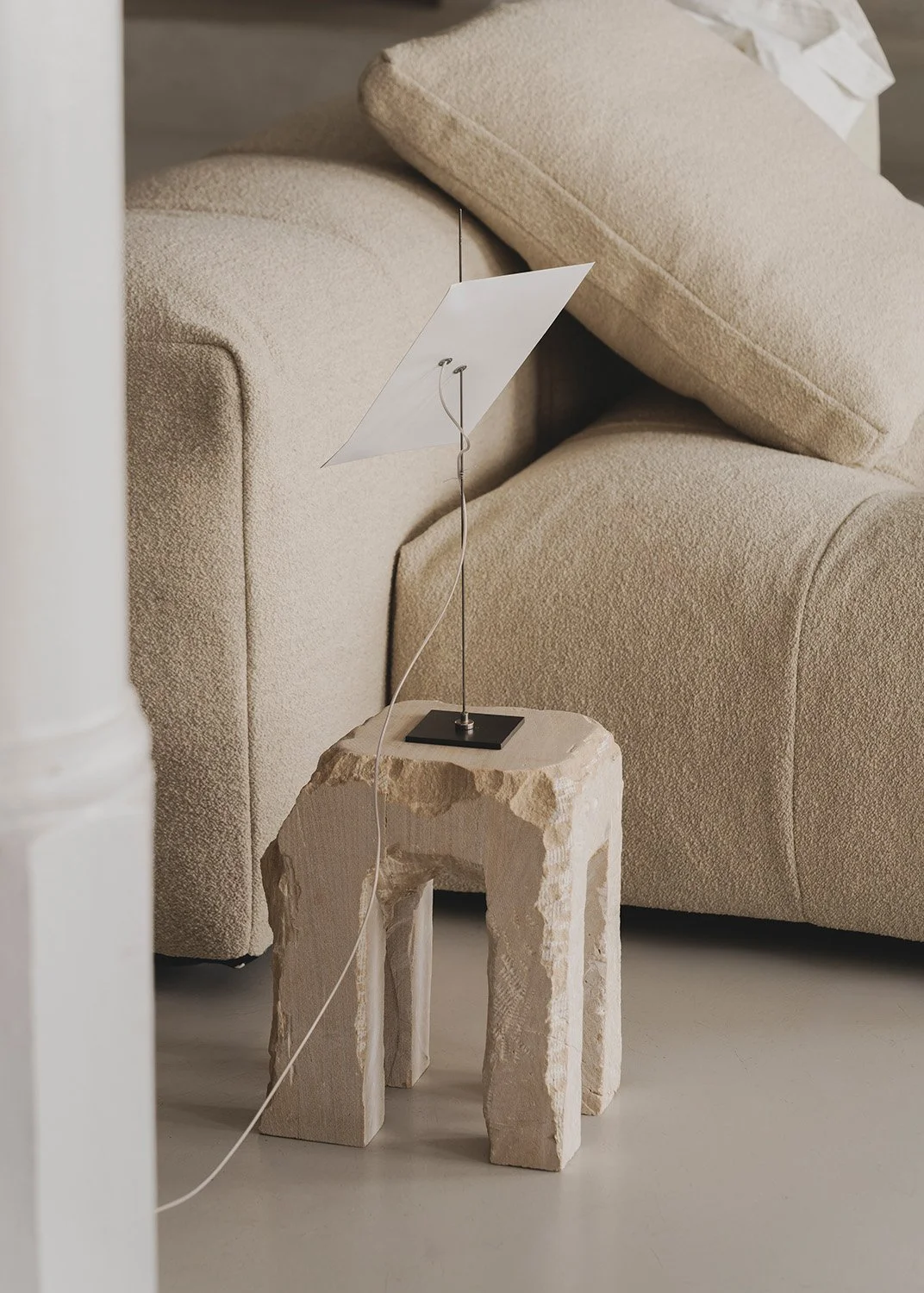
The Live Editorial of Charlotte Taylor
ORDER, PLAY & CAOS
-
Interview to Charlotte Taylor for Openhouse magazine Nº20.
-
Written by Inma Buendia inmabuendia.com
Photographed by Enric Badrinas enricbadrinas.com
Side Gallery side-gallery.com
Charlotte Taylor @charlottetaylr
-
ORDER PLAY & CAOS
A huge space with barely any walls, surrounded by windows, with floors and ceilings all in one colour, comes into view. It's difficult to guess its purpose: is it a home, an office, a gallery, or all of the above at once? As the gaze gradually distinguishes the details, there's a table set, perhaps for guests, and an unmade bed with a laptop on it. Hobbies lie on a desk, a small table holds a chess set, and various utilitarian objects like chairs, ashtrays and wine glasses, with great sculptural appeal, could well be exhibited in a museum.
This is the first 'live editorial' by Openhouse. An installation by Charlotte Taylor that reinterprets what we call home in an imposing setting: Side Gallery, a contemporary artefact in its forms but classic in its purpose, to preserve and arrange historical records related to Latin American design of the past century. The majestic work carried out by Guillermo Santomá in the 700 square metres of this gallery in Barcelona is clad in nothing but concrete. This material serves to unify such a vast space into a single formal and functional piece. A body of work in which Luis Sendino, curator and founder of the Side Gallery, alternates tradition and avant-garde in a melancholic approach to the past that invites dreaming of possible futures.
In that sort of temporal parenthesis seems to lie Charlotte Taylor's creative proposal. Unaffected by the aesthetic noise around, her workspace is the inexhaustible archive of images that this artist and designer catalogues in her mind, creating synergies between art and everyday life, between play and chaos. To orbit in the same place as Charlotte is to be imbued by the calm - not docile - character she conveys with each step. A disposition from which sophisticated, lively spaces with a great sense of humour are born. Charlotte is the first guest to develop, alongside talented creators from all over the world, the live editorial that inaugurates OpenArchive, the life we share.
How did you incorporate the personal tastes and preferences of Openhouse and Side Gallery into your design?
There was already a synergy between Openhouse, Side Gallery and personal style so the result was more a collage of overlaying some of my more specific tastes into a palette that feels familiar. The sudoku unmade beds and striped shirts are definitely a signature of mine that brings a bit of disarray.
What part of the project did you enjoy the most?
Watching people interact with the space and pieces. There were a group of children who started playing chess which was my favourite moment I caught a glimpse of.
How does the curation of art in a house-gallery differ from traditional gallery spaces, and how does the design facilitate this distinction?
The domestic side to the space brings that very personal element to the gallery and is an invitation to react with the space and pieces in a more casual and explorative way. Movement and people’s journey throughout the space is a very different consideration, to have people lean and lounge on the pieces and become of the show as opposed to purely a visitor to the show. Taking the gallery experience beyond the visual perspective and engaging the other senses.
How do you create cohesive environments that look both elegant and effortlessly vigorous?
Maintaining an element of play and chaos and allowing things to have a sense of movement and openness, away from a highly considered yet static space.
Are there specific design objects or materials that you find particularly effective in achieving this balance?
Objects go a long way in offsetting a space and bringing a notion of personality and breaking a rigid arrangement.
How do cultural and historical elements inspire your design work?
I am always drawing inspiration from different historical/cultural eras and movements of design. Drawing on the similarities and contrasts, amalgamating references into something new yet very rooted in the past.
How do you see the relationship between design and other art disciplines in your work?
It’s very fluid. My process is very much bouncing between art and design practices. It’s inseparable for me as everything feeds into one another and design as a means itself can’t be isolated from the wider creative world.
What would you say is the main challenge you face as a designer and how do you overcome it?
Actualising ideas. There’s always 100+ ideas that I can get really excited by and passionate about but it's impossible to be able to develop and keep up with the speed of your imagination. It’s frustrating to see so many ideas dissolve and never take shape. Prioritising the projects and concepts that I’m most driven by and trying to allocate a dedicated time and schedule rather than starting multiple things at once is helping to keep the momentum but not dilute the designs.
What has your design journey and the influences that have shaped your aesthetic?
My personal design journey has been a bit of a winding and unconventional one to reach architecture. Passing through a range of mediums and disciplines within design has shaped my interdisciplinary approach and aesthetic. Having a Fine Art education has also been very defining in my journey, allowing a very playful and unconstrained perspective to the design processes and protocols.
How do you envision the future of design, and what role do you hope to play in shaping it?
I see it becoming more and more collaborative, not just within traditionally deemed creative fields but inclusive of all fields and sectors. Honouring the creativity of scientists, mathematicians, ecologists and design becoming the product of many, not a single designer/architect/artist. I would love to work with and learn from fields I am not familiar with and start conversations around creative ways of working together.

EVERY FORM OF POETRY
GABRIEL ESCÁMEZ
SELECTED BY GABRIEL ESCÁMEZ
-
Photos by Clemente Vergara.
Words by me ;)
Cobalto Studio. -
Gabriel Escámez embodies everything one can attribute to a total artist. He possesses genius, sensitivity, charisma, overflowing energy, and great determination to achieve the desired outcome in each of his projects. When you are near someone with the tenacity and talent he possesses, their energy rubs off on you, which drives you to strive for excellence.
We find him at Cobalto Studio, the space that Gabriel and his team inhabit in Barcelona. A sort of art gallery, creative workshop, sensory archive, and office adorned with objects that are as emotive as they are beautiful. The entrance greets us with intriguing pieces of noble and pure materials. To the left, a long table is positioned in front of the glass facade, activating a dialogue between the interior and exterior. At the back of the studio, a resting area or small lounge leads to the more functional space. A wardrobe runs along the area of work tables. A hat, several drawings, photographs, ceramics, and other unique objects rest on top of it.
Gabriel shows us some of the items he has brought to add a personal touch to the article: the guitar that once belonged to his father, his unintended collection of white Vans sneakers, and some effects that are part of his particular creative universe. His enthusiasm for including them in the selection is more than noticeable. At the end of our visit, he decides that one of the 'artistic installations' he has arranged for the photos will be exhibited at Cobalto Studio for at least a few hours. "Could be fun, right?" he asks rhetorically in a question that summarizes all his persona at once.
After photographing the objects chosen for this 'Selected by,' we sit down to chat over a cup of coffee around the majestic table that welcomes Cobalto Studio’s visits. Relaxed, delighted by the soft winter sun streaming in through the windows, we converse about poetry, music, work and life in a brief but exquisite gathering.


Do you remember the first time you bought something with a collector's consciousness?
I don't think I've ever bought with the intention of collecting, just something I loved at that moment and wanted to have. There's something very romantic and poetic about how things age. It's not just the piece itself but its evolution. The study or appreciation of its aging process. There are nuances that can't be achieved otherwise.
What is the main characteristic that attracts you to an object?
I believe it's a matter of proportion. Volume is essential. Then also the story it may carry: the patina, the aging, and the materiality.
Have you always created spaces? Do you remember yourself, even as a child, doing so?
Yes, I made still lifes at four years old. It's something that came to me very naturally and it's healing because when I do it, the perception of time disappears, and I feel good.
How do you think the beauty of our surroundings influences our mood?
This journey we're on here, at least in my case, if it isn't surrounded by beauty, would probably lack meaning.
In your interior design projects, you seek to connect the space with the most primal aspect of the place. How do you go about that search?
First, you have to interpret the space, the location, and the many factors that influence it, to then be able to develop the space's own story. Fortunately, we have many clients who allow us to generate the storytelling from scratch and even want each space to have uniqueness. It's something that keeps me alert and prevents me from getting bored.
Regarding the selected objects for this article, tell us about the Vans. What attracts you to them? When and how did you decide to bring this collection to us?
Well, I think it happens to a lot of people. When you get used to a pair of shoes and you find it impossible to stop wearing them even in inappropriate moments. You're dressed in a tuxedo and suddenly you want to wear Vans because you can't see yourself with any other footwear even though I have other very interesting ones too. Thinking about how to bring the selection closer to the character, it occurred to me that this really defines me.
What can you tell us about your father's guitar that is part of the selection?
I brought it because I started again with lessons and wanted to play this specific guitar, but in the end, I decided to go back to the piano. It's always beautiful to have something from my father who is no longer here. It symbolizes him and is still part of his presence and his enthusiasm that accompanies me.
Is there any place that if you could collect, would be part of your particular 'Selected by'?
One of the spaces that has given me the most Stendhal syndrome has been the Maeght Foundation. I think it's the most barbaric and beautiful place I've ever been. I would love to live there. I like the materiality, the place, the vegetation, the art pieces... everything. I believe it's the epitome of everything I expect from life.
How was the design and search for the current Cobalto Studio?
I found this place with the idea of having a more comfortable space to centralize the warehouse and the studio. Now we are much more focused on art direction, set design, interior architecture, and projects that are more related to the essence of the studio. The cataloging of the space and everything related to the archive is only 3% of what we do today.
When and how was La Cobalta born?
It started parallel to Cobalto and emerged to discuss topics that were the soul of Cobalto, generating a language that appeals to the poetic, the cultural, and the wildness of the Mediterranean coast.
There is a lot of poetry in your life. It is very present in your way of explaining your work.
I love reading poetry but poetry isn't only written, you can find poetic elements in an act, in a light, in a photograph, in a person, in the way someone else speaks...
What projects excite you now?
Well, I'm very happy with projects that are to generate spaces but where storytelling is very much linked. It's much more fun because we can generate concepts linked to the overall image that don't just involve space. It's much richer, it's more sociocultural.
Music is also very present in Cobalto and in your personal life. What do you listen to the most?
What I listen to the most, and I think it also goes very much in line with what we have represented in the selection and representation of objects, is jazz. I love everything that was done in the early 20s of African music, but derived towards jazz. It's like a reinterpretation of cubism-brutalism. It's cubist, but taken to the African. If I had to summarize it in just one song, it would be the ‘Love Theme From Spartacus' by Yusef Lateef included in the Eastern Sounds album of 1961.