The Live Editorial of Charlotte Taylor
ORDER, PLAY & CAOS
-
Interview to Charlotte Taylor for Openhouse magazine Nº20.
-
Written by Inma Buendia inmabuendia.com
Photographed by Enric Badrinas enricbadrinas.com
Side Gallery side-gallery.com
Charlotte Taylor @charlottetaylr
-
ORDER PLAY & CAOS
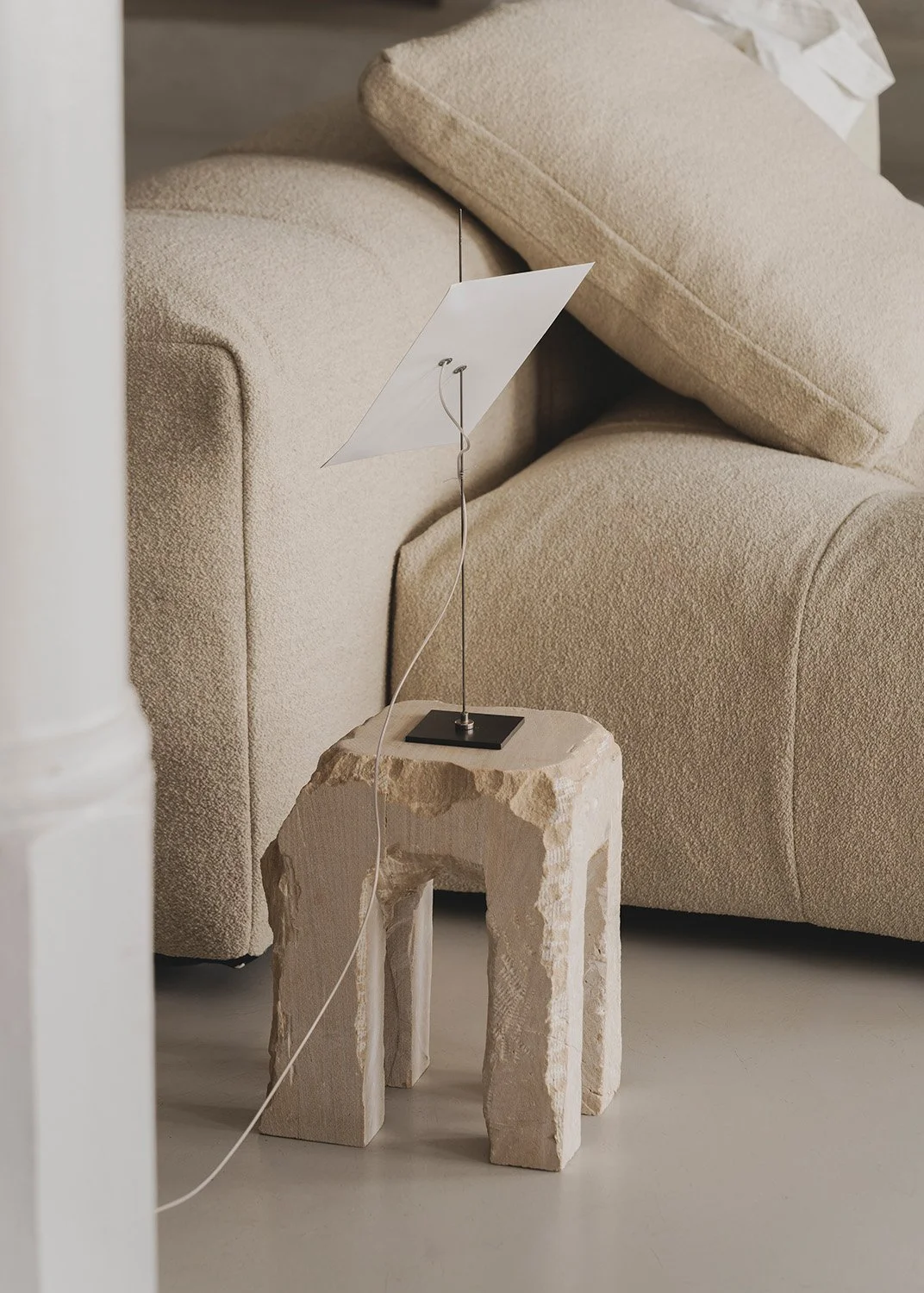
A huge space with barely any walls, surrounded by windows, with floors and ceilings all in one colour, comes into view. It's difficult to guess its purpose: is it a home, an office, a gallery, or all of the above at once? As the gaze gradually distinguishes the details, there's a table set, perhaps for guests, and an unmade bed with a laptop on it. Hobbies lie on a desk, a small table holds a chess set, and various utilitarian objects like chairs, ashtrays and wine glasses, with great sculptural appeal, could well be exhibited in a museum.
This is the first 'live editorial' by Openhouse. An installation by Charlotte Taylor that reinterprets what we call home in an imposing setting: Side Gallery, a contemporary artefact in its forms but classic in its purpose, to preserve and arrange historical records related to Latin American design of the past century. The majestic work carried out by Guillermo Santomá in the 700 square metres of this gallery in Barcelona is clad in nothing but concrete. This material serves to unify such a vast space into a single formal and functional piece. A body of work in which Luis Sendino, curator and founder of the Side Gallery, alternates tradition and avant-garde in a melancholic approach to the past that invites dreaming of possible futures.
In that sort of temporal parenthesis seems to lie Charlotte Taylor's creative proposal. Unaffected by the aesthetic noise around, her workspace is the inexhaustible archive of images that this artist and designer catalogues in her mind, creating synergies between art and everyday life, between play and chaos. To orbit in the same place as Charlotte is to be imbued by the calm - not docile - character she conveys with each step. A disposition from which sophisticated, lively spaces with a great sense of humour are born. Charlotte is the first guest to develop, alongside talented creators from all over the world, the live editorial that inaugurates OpenArchive, the life we share.


How did you incorporate the personal tastes and preferences of Openhouse and Side Gallery into your design?
There was already a synergy between Openhouse, Side Gallery and personal style so the result was more a collage of overlaying some of my more specific tastes into a palette that feels familiar. The sudoku unmade beds and striped shirts are definitely a signature of mine that brings a bit of disarray.
What part of the project did you enjoy the most?
Watching people interact with the space and pieces. There were a group of children who started playing chess which was my favourite moment I caught a glimpse of.
How does the curation of art in a house-gallery differ from traditional gallery spaces, and how does the design facilitate this distinction?
The domestic side to the space brings that very personal element to the gallery and is an invitation to react with the space and pieces in a more casual and explorative way. Movement and people’s journey throughout the space is a very different consideration, to have people lean and lounge on the pieces and become of the show as opposed to purely a visitor to the show. Taking the gallery experience beyond the visual perspective and engaging the other senses.
How do you create cohesive environments that look both elegant and effortlessly vigorous?
Maintaining an element of play and chaos and allowing things to have a sense of movement and openness, away from a highly considered yet static space.
Are there specific design objects or materials that you find particularly effective in achieving this balance?
Objects go a long way in offsetting a space and bringing a notion of personality and breaking a rigid arrangement.
How do cultural and historical elements inspire your design work?
I am always drawing inspiration from different historical/cultural eras and movements of design. Drawing on the similarities and contrasts, amalgamating references into something new yet very rooted in the past.
How do you see the relationship between design and other art disciplines in your work?
It’s very fluid. My process is very much bouncing between art and design practices. It’s inseparable for me as everything feeds into one another and design as a means itself can’t be isolated from the wider creative world.
What would you say is the main challenge you face as a designer and how do you overcome it?
Actualising ideas. There’s always 100+ ideas that I can get really excited by and passionate about but it's impossible to be able to develop and keep up with the speed of your imagination. It’s frustrating to see so many ideas dissolve and never take shape. Prioritising the projects and concepts that I’m most driven by and trying to allocate a dedicated time and schedule rather than starting multiple things at once is helping to keep the momentum but not dilute the designs.
What has your design journey and the influences that have shaped your aesthetic?
My personal design journey has been a bit of a winding and unconventional one to reach architecture. Passing through a range of mediums and disciplines within design has shaped my interdisciplinary approach and aesthetic. Having a Fine Art education has also been very defining in my journey, allowing a very playful and unconstrained perspective to the design processes and protocols.
How do you envision the future of design, and what role do you hope to play in shaping it?
I see it becoming more and more collaborative, not just within traditionally deemed creative fields but inclusive of all fields and sectors. Honouring the creativity of scientists, mathematicians, ecologists and design becoming the product of many, not a single designer/architect/artist. I would love to work with and learn from fields I am not familiar with and start conversations around creative ways of working together.
MARCOS PALAZZI
PORTRAITS OF LIFE
-
Interview to Marcos Palazzi for Openhouse magazine Nº20.
-
Written by Inma Buendía inmabuendia.com
Photographed by Fabián Martínez fabianml.com
Marcos Palazzi marcospalazzi.com -
PORTRAITS OF LIFE
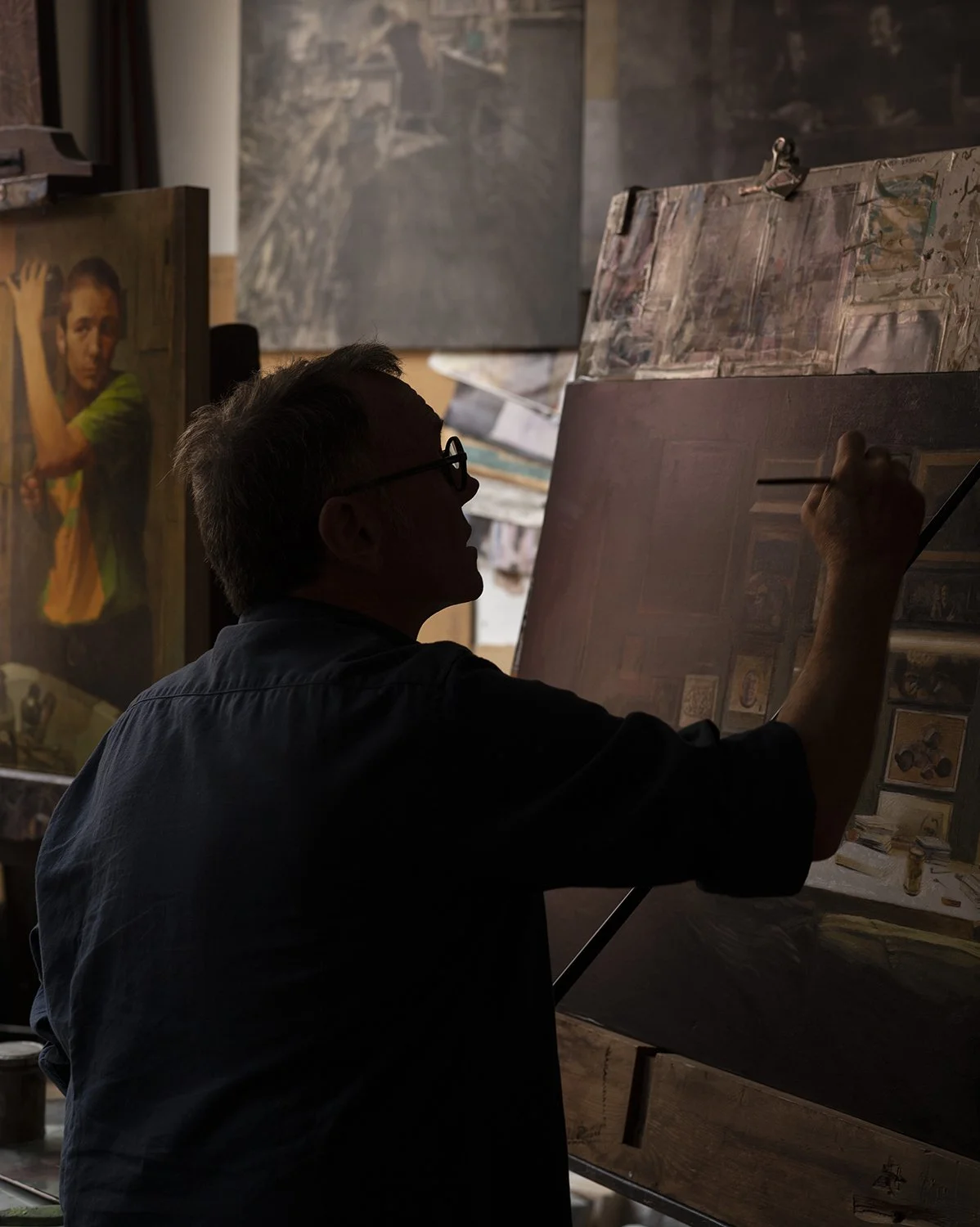
Entering Marcos Palazzi’s (Barcelona, 1965) studio is, in a way, like entering his home. This Catalan artist, whose greatest virtue is humility, turns everyday things into art. His inspiration, drawn from his emotional surroundings, fuels his mainly pictorial work that revolves around drawing, photography, memory and a sense of humour.

We meet his daughter Lucía in what seems like an almost Costumbrist scene like those depicted in Palazzi’s work, and, amid laughter, memories and anecdotes, she reveals her father’s career and personality whenever he plays down some of his achievements.
Everything in Marcos Palazzi’s story seems to take place in a continuous present, as if we were in a story by George Orwell where only the here and now matters. So that when I ask him how and when he met Marta, his wife: “In Puigcerdà, I suppose. Years ago. I used to go to a friend’s house and she had a house there.” His work is a way of capturing moments. Many of the paintings around us are family scenes featuring his three children, his wife and himself. “It’s harder to paint children when they're small, it’s more difficult. I painted them several times in a large format. They all sold. It's funny because, who wants a painting of a child?” he muses. “When we went to exhibitions,” Lucía explains, “my brothers and I counted how many times we were in the paintings to see who would win. One day at the beach,” she continues, “a boy who was playing with us said that my brother looked very familiar. Suddenly it dawned on him that there was a painting in his home of my brother Simon pulling at a tooth. Of course, someone has a child and someone has Simon. Someone has me or someone has my mother, my cats or my dad. People buy us, yes.”
While Fabián and Lucía arrange the space to shoot the portraits, I do the same with words, trying to find out if an artist is born or made. “I’ve always drawn, ever since I was a little boy. I also like comics a lot. Even then I was very inspired by the underground comic artist Robert Crumb and all his work. The comic Dossier Negro was more about horror stories, but it had very good cartoonists, almost all of them Americans,” explains Marcos.

It was the 1970s in Barcelona, a time when it wasn’t easy to find these comics. “My uncle would buy them all. Although he was a doctor, he was very fond of comics. He’d let me go into his room and read some of them, but just a few. Later, I’d borrow Will Eisner's much-loved comic The Spirit from a newsagent’s. The girl who ran it let me, and she was more discreet about it than I was.” Marcos says that he partly credits his profession to an accident he had shortly before taking his university entrance exams. “I was in a coma for seven days after the accident, I didn’t study at all and I failed. Instead of doing Fine Arts, I enrolled at EINA (Centro Universitario de Diseño y Arte de Barcelona) because I was advised to by the designer América Sánchez. He taught there. Shortly afterwards I got into the Massana school and the Llotja, which I also used as a studio.” Soon after, Marcos won a competition organised by the Parés Gallery in Barcelona (where he continues to exhibit) and art became his livelihood.
Art is not only Marcos’s profession but also the place to which he belongs, the community in which he has been immersed since he started out. “When I was 22 or 23 years old, we had a group called San Paulino. It was the name of the street where we had the studio, an abandoned school in the upper part of Barcelona that they let me use. We thought of having an exhibition to avoid the galleries. It lasted a day and was a lot of fun. We sold quite a lot. We did it every year.”
Today, his studio is a hidden gem in Barcelona’s Gothic Quarter, the kind where you enter through a modest courtyard and up a narrow staircase. Nothing indicates what you’ll find when you cross the threshold: large semi-arched windows, hundreds of artworks of all sizes, images, stickers, peculiar objects... “Upstairs you will find Artigau, a Pop Art artist, so to speak, who is 83 years old. He was my teacher and I’d come and visit him from time to time. One day, I asked him to let me know if his downstairs neighbour ever left because I'd like to rent the studio if I possibly could, and I’ve been here for ten years now.” Lucía acts as our guide: “Mateo here doesn’t look like Mateo,” she says, pointing to a painting of her brother. “And that is the farewell to my dog in the kitchen, when we had to have him put him down,” she explains, while standing next to another of the paintings that, like a photo album, amass milestones from her own life.
MARCOS PALAZZI
RETRATOS DE VIDA
-
Carta del editor para el Nº20 de Openhouse magazine.
-
Escrito por Inma Buendía inmabuendia.com
Fotografiado por Fabián Martínez fabianml.com
Marcos Palazzi marcospalazzi.com -
RETRATOS DE VIDA
Entrar en el estudio de Marcos Palazzi (Barcelona, 1965) es, de alguna manera, entrar en su casa. Este artista catalán cuya mayor virtud es la humildad, convierte en arte aquello que es cotidiano. Su entorno emocional es el material con el que nutre una obra principalmente pictórica que se vertebra sobre ejes como el dibujo, la fotografía, la memoria y el sentido del humor.
Casi como en una escena costumbrista de las que él mismo plasma en sus obras, acudimos a la cita junto a su hija Lucía, quien entre risas, recuerdos y anécdotas, va desvelando la trayectoria y personalidad de su padre cada vez que éste resta importancia a alguna de sus gestas.
Todo en la historia de Marcos Palazzi parece suceder en un presente contínuo, como si nos situásemos en una obra de George Orwell donde sólo cuenta el ahora. Así sucede cuando le pregunto cómo y cuándo conoció a Marta, su mujer: “En Puigcerdà, supongo. De siempre. Yo iba a casa de un amigo y ella tenía casa allí”. Su obra es una forma de capturar momentos. Muchos de los cuadros que nos rodean son escenas familiares protagonizadas por sus tres hijos, su mujer y él mismo. “Cuando los niños son pequeños, cuesta más pintarlos, es más difícil. Y eso que los hice varias veces en grande. Se vendieron, es una cosa curiosa, ¿quién quiere un niño?”, reflexiona. “Cuando íbamos a las exposiciones”, explica Lucía, “mis hermanos y yo contábamos cuántas veces salíamos en los cuadros para ver quién ganaba. Un día en la playa”, continúa, “un niño que estaba jugando con nosotros decía que mi hermano le sonaba mucho. De repente cayó en la cuenta de que en casa tenía un cuadro de mi hermano Simón estirándose un diente. Claro, alguien tiene un niño y alguien tiene a Simón. Alguien me tiene a mí o alguien tiene a mi madre, a mis gatos o a papá. La gente nos compra, sí”.
Mientras Fabián y Lucía disponen el espacio para disparar los retratos, yo hago lo propio con las palabras tratando de averiguar si el artista nace o se hace. “Siempre he dibujado, desde que era pequeñito. También me gusta mucho el cómic. Ya entonces me inspiraba mucho todo el trabajo de Robert Crumb, que era underground. La revista Dossier Negro era más de historias de terror pero tenía dibujantes muy buenos, americanos casi todos”, explica Marcos.
Eran los años 70 en Barcelona, cuando no era tan sencillo acceder a dichas referencias. “Mi tío era quien se los compraba todos. Aunque es médico, le gustaba mucho el cómic. Me dejaba entrar en su habitación y leer alguno, pero pocos. Después, tomaba prestado el siempre adorado comic Spirit de Will Eisner de un kiosko. La chica que lo atendía me lo permitía, disimulando ella más que yo”. Marcos otorga parte del mérito de dedicarse a su profesión al accidente que sufrió poco antes de examinarse de selectividad. “Estuve siete días en coma tras el accidente, no estudié nada y suspendí. En lugar de entrar en la carrera de Bellas Artes, me matriculé en EINA (Centro Universitario de Diseño y Arte de Barcelona) porque América Sánchez, el diseñador, me lo recomendó. Él era profesor allí. Y poco después ingresé en la Escuela Massana y en la Llotja, que además me servía como estudio”. En seguida ganó un concurso organizado por la Galería Parés de Barcelona (con quienes continúa exponiendo) y empezó a ganarse la vida como artista.
El arte no es únicamente la profesión de Marcos sino el lugar al que pertenece, la comunidad en la que se halla inmerso desde sus comienzos. “A los 22 o 23 años teníamos un colectivo que se llamaba San Paulino. Era el nombre de la calle en la que teníamos el estudio, una escuela abandonada en la parte alta de Barcelona que me dejaron usar. Pensamos en hacer una exposición para saltarnos a las galerías. Duraba un día y era muy divertido. Se vendía bastante. Lo hacíamos cada año”.
Hoy su estudio es una joya escondida en el barrio Gótico de Barcelona, de aquellas a las que accedes a través de un modesto patio y una angosta escalera. Nada en ese recorrido hace prever lo que nos encontraremos al cruzar el umbral: grandes ventanas con forma de semiarco, cientos de obras de todos los tamaños, imágenes, pegatinas, objetos curiosos…“En el piso de arriba está Artigau, que es un pintor pop, por así llamarlo, de 83 años. Era mi profesor y yo venía a verlo de tanto en tanto. Un día le dije que me avisase cuando se fuese el vecino de abajo porque yo alquilaría el estudio, en la medida posible, y ya llevo diez años.”Lucía hace las veces de guía: “Mateo aquí no se parece a Mateo”, dice señalando un cuadro que retrata a su hermano. “Y esa es la despedida de mi perro en la cocina, cuando tuvimos que sacrificarlo”, explica junto a otra de las imágenes que, como en un álbum, recogen hitos de su propia vida.
Fabián comienza a fotografiar al artista que quiere ponerse su chaqueta favorita (verde a cuadros) para la imagen: “Cuando pienso en mi padre, pienso en esta chaqueta tan fea. Siempre la lleva. Es su look, su personaje”, señala Lucía. Es la relación que Marcos mantiene con varios objetos que nos rodean: “Esto es un trozo de hierro donde hacía las mezclas. Lo de debajo es una mesita típica pero siempre la he tenido cariño”, comenta acercándose a una especie de bandeja cubierta de colores.
De pie junto a la ventana de su pequeña tramoya de artefactos hiperrealistas, se puede intuir que Marcos Palazzi ha tenido una vida plena. Quizá su secreto no sea llegar más o menos lejos, o tener más o menos éxito. Puede que la llave de la felicidad en su caso se encuentre en la vida familiar. Una vida que retratar.
OPENHOUSE EDITORIAL
EL ACTO DE COMPARTIR
EL ACTO DE COMPARTIR
-
Carta del editor para el Nº20 de Openhouse magazine.
-
Desde que Openhouse lanzase su primer número en 2014, el mundo ha reconceptualizado el término compartir. Hoy, este posee muchas más acepciones, más matices, más escenarios y más soportes. Sin embargo, en muchos de sus significados actuales, compartir se vincula a un individuo que emite ideas o emociones de forma unilateral desde un espacio físicamente cerrado, en muchos casos a través de las redes sociales. Se trata de una manera de derribar las fronteras que nos permite conectar en tiempo real con personas de todo el mundo, solo que a través de un dispositivo individual como es el teléfono. En soledad pero al mismo tiempo en compañía.
Para Openhouse como proyecto, incluso antes de convertirse en una publicación, la idea de compartir hace referencia a una acepción más social, vinculada al encuentro físico y comunal. Del mismo modo que en el eterno enigma: “si un árbol cae en un bosque y nadie está cerca para oírlo, ¿hace algún sonido?”; si tenemos un talento o un don que nadie conoce, ¿realmente podemos defender que es una habilidad real? Publicado en 2014, el Nº1 de Openhouse magazine nacía con un slogan: The Life we Share. Una frase que describe, casi con literalidad, lo que Andrew Trotter y Mari Luz Vidal, fundadores de la revista, hacían por entonces en su propia casa. Un apartamento en el centro de Barcelona que no sólo compartían como compañeros de piso, sino que convirtieron en un proyecto en sí mismo cuando decidieron abrir sus puertas a quien quisiera disfrutar de las diferentes actividades culturales que ambos empezaron a programar. Dicho ‘acto de compartir’ sigue latente bajo la piel que habita la revista Openhouse. Veinte números después, es indescriptible la emoción que sentimos al echar la vista atrás. Son muchas las personas que comenzaron siendo nombres de profesionales a los que admiramos, y hoy podemos considerar amigos. Arquitectos, artistas, curadores y creadores que nos abrieron las puertas de sus casas para que nos sintiéramos como si estuviéramos en la nuestra. John Pawson, la familia Gomis, Jan y Lin Utzon, Hértor Barroso, César Cervantes, Christian Bourdois y Eva Albarrán en las Solo Houses… El listado es abrumadoramente largo.

Pero no solo nos llenamos de emoción al repasar lo vivido. También lo hacemos cuando alzamos la mirada para prever lo que está por llegar. En este número, nos rodeamos de caras ya conocidas como las de Vincenzo y Claudia Rose de Cotiis, quienes tienen la gran amabilidad de mostrarnos su nuevo proyecto en Venecia. Una oda al arte italiano que es una obra de arte en sí misma.
Visitamos Casa Soleto, el proyecto personal de Andrew Trotter y Marcelo Martínez. Un hogar lejos de casa en cuya renovación los hemos visto trabajar duro pero también vibrar durante los últimos dos años. Hoy es una realidad que hospeda a quien quiera vivir una experiencia casi espiritual en Puglia, Italia.
Al otro lado del océano, en Ciudad de México, Graciela Iturbide y Mauricio Rocha se sientan a la mesa en el Estudio Iturbide junto a su amiga, la artista Claudia Fernández. Alrededor de un delicioso pastel y una botella de tequila, madre e hijo nos hablan de sus respectivos procesos creativos, como fotógrafa y arquitecto, de sus primeros pasos profesionales y repasan la historia familiar entre anécdotas, recuerdos y risas.
No muy lejos de allí, en San Francisco, Ira Kurlander nos abre las puertas de su casa; un hogar diseñado por el propio arquitecto donde el estilo mid-century convive con la ensoñación creativa y un cierto toque surrealista. Sin dejar de lado la parte más lúdica de la creación, volvemos a Barcelona para visitar el estudio del artista Marcos Palazzi quien, con su pintura, invita a reflexionar sobre temas universales a través del retrato de escenas íntimas y familiares.
Si hay algo que he aprendido desde que comenzase a trabajar en Openhouse magazine en 2015, es que compartir y capturar momentos de nuestras vidas, a través de cualquier tipo de disciplina o soporte, es un acto íntimo que permanece dentro de nuestra memoria física pero también emocional. En Openhouse nos gusta pensar que continuamos siendo un lugar de encuentro. Seguimos estrechando lazos con personas creativas de todo el mundo y nos gusta hacerlo como siempre lo hemos hecho: invitándoles a entrar, a sentarse y a charlar.
OPENHOUSE EDITOR’S LETTER
THE ACT OF SHARING
THE ACT OF SHARING
-
Editor’s letter of Openhouse magazine Nº20.
-
Since Openhouse launched its first issue almost ten years ago, the world has reconceptualized the term sharing. Today, it has many more meanings, more nuances, more scenarios and more platforms. However, in many of its current meanings, sharing is linked to the idea of an individual who unilaterally emits ideas or emotions from a physically closed space, in many cases through social networks. It is a way of breaking down borders that allows us to connect in real time with people from all over the world, but only, and here is the catch, while holding tight to the small physical world of an individual device such as a smartphone. In solitude but at the same time in company.
For Openhouse as a project, even before becoming a publication, the idea of sharing refers to its social meaning, linked to the physical and communal encounter. In the same way as in the eternal enigma: “if a tree falls in a forest and no one is around to hear it, does it make a sound?”; If we have a talent or gift that no one knows about, can we really defend that it is a real ability?
Published in 2014, Openhouse magazine's No. 1 was born with a slogan: The Life we Share. A phrase that describes, almost literally, what Andrew Trotter and Mari Luz Vidal, founders of the magazine, were doing at that time in their own home. An apartment in the center of Barcelona that they not only shared as roommates, but also turned into a project in itself when they decided to open its doors to anyone who wanted to enjoy the different cultural activities that they both began to program. This 'act of sharing' is still latent under the skin that Openhouse magazine inhabits. Twenty issues later, the emotion we feel when we look back is indescribable. There are many people who began as names of professionals whom we admire, and today we can consider friends. Architects, artists, curators and creators who opened the doors of their homes to us so that we felt as if we were in our own home. John Pawson, The Gomis family, Jan and Lin Utzon, Héctor Barroso, César Cervantes, Christian Bourdais and Eva Albarrán… The list is overwhelmingly long.
But we are not only filled with emotion when reviewing what we experienced. We also do it when we look up to foresee what is to come. In this issue, we surround ourselves with already known faces such as Vincenzo and Claudia Rose de Cotiis, who are kind enough to show us their new project in Venice. An ode to Italian art that is a work of art in itself.
We visited Casa Soleto, the personal project of Andrew Trotter and Marcelo Martínez. It is a home away from home, whose renovation we have witnessed through their hard work and enthusiastic joys over the last two years that welcomes anyone who wants to live an almost spiritual experience in Puglia, Italy.
Across the ocean, in Mexico City, Graciela Iturbide and Mauricio Rocha sit at the table in the Estudio Iturbide with their friend, the artist, Claudia Fernández. Around a delicious cake and a bottle of tequila, mother and son tell us about their respective creative processes, as a photographer and as an architect, about their first professional steps, and share their family history through anecdotes, memories and laughter.
Not far from there, in San Francisco, Ira Kurlander opens the doors of his house to us; a home designed by the architect himself where the mid-century style coexists with creative dreaminess and a certain surreal touch. Holding that sense of creative play in our minds, we return to Barcelona to visit the studio of the artist Marcos Palazzi, whose paintings of intimate and family scenes invite us to recognize the universal themes we share.
If there is one thing I have learned since I started working at Openhouse magazine in 2015, it is that sharing and capturing moments of our lives, through any type of discipline or platform, is an intimate act that remains within our physical and emotional memory.
At Openhouse we like to think that we continue to be a meeting place. We continue to strengthen ties with creative people around the world and we like to do it as we always have: inviting them to come in, sit down and chat.
CASA BERNAL
LA FLOR ENTRE LOS ESCOMROS
LA FLOR ENTRE LOS ESCOMBROS
-
Reportaje sobre Casa Bernal para Openhouse magazine Nº20.
-
Escrito por Inma Buendía inmabuendia.com
Fotografiado por Luis Garvan luisgarvan.com
Chic by Accident chicbyaccident.com -
Openhouse magazine Nº20
La historia recoge, como si se tratase de heroicidades, las gestas de personajes que se abrieron paso en sus vidas a pesar de las circunstancias. Si bien la sociedad está de acuerdo en la perseverancia y fortaleza de estos referentes sociales, poco se habla de la intuición, del estado mental que permite a nuestros sentidos detectar los momentos en lo que debemos actuar, las oportunidades que no debemos dejar pasar.
Marcos Ruiz es de aquellas personas que poseen un gran instinto, que se deleitan en el proceso de construir y construirse. Me encuentro con él en su casa de Ciudad de México. Un lugar con pocas piezas de mobiliario pero en cuya elección se intuye una meditada decisión. Todas poseen un gran peso, una extraordinaria presencia y un fuerte carácter. Sentados en su majestuoso sofá, Marcos intenta resumir sus andaduras profesionales pasadas, presentes y futuras, mientras yo atisbo rasgos en común en todas ellas: un refinado gusto estético y un sincero interés tanto por la historia de la humanidad como por los objetos que han adornado dichos episodios hasta nuestros días. “Creo en el interiorismo como una colección, pues es una manera de expresión. Al final del día estás contando una historia. Es un lenguaje total; un lenguaje muy abstracto, pero se logra contar una historia con eso”, explica.
Nacido y criado en Querétaro, Marcos lleva más de quince años en la Ciudad de México, aunque ha vivido en otros lugares de forma eventual.“Cuando me mudé aquí me empecé a familiarizar con las galerías de la ciudad”. Poco a poco, fue aprendiendo el oficio de curador, de coleccionista, y a adquirir un criterio artístico que lo llevó a crear su propio universo creativo. Siempre fue admirador de la arquitectura, del diseño y del arte, a pesar de tener otro background. “El proceso creativo para dar vida a una idea me fascina. Y el interiorismo me emociona muchísimo. Es de las cosas que más disfruto”. Por eso, cuando su familia decidió deshacerse del cúmulo de escombro en el que se había convertido Casa Bernal, Marcos se propuso salvarla y devolverla a la vida.
Símbolo de una época clave en la historia de México, la casa había dado servicio a su comunidad: “Está situada en un pueblo muy pequeño donde no había lugar en el que guardar y sacar dinero como es el Banco de México. Todas las compañías mineras que están en la Huasteca Potosina, hacían escala allá antes de ir a la Ciudad de México, y la casa funcionaba como una especie de banco. Después de la revolución, fue saqueada y quedó abandonada.”


Para realizar el proyecto de Casa Bernal, Marcos se apoyó en Chic by Accident, el estudio de Emmanuel Picault: “Fue una experiencia muy motivante y enriquecedora. Emmanuel tiene un ojo impecable y una estética escenográfica que se ve reflejada en la casa”. Marcos habla desde su propia experiencia porque el diseñador le entregó las llaves poco antes de que estallara la pandemia. La Ciudad de México quedó desierta, así que decidió mudarse temporalmente a Bernal. “Pasamos como unos cuatro o cinco meses allá con dos colchones. No hay nada como disfrutar la casa viviéndola. Es un pueblo muy pequeño, muy hermoso pero muy tranquilo. Yo salía en la mañana a comprar huevos en pijamas y no había nadie. Era una locura”.
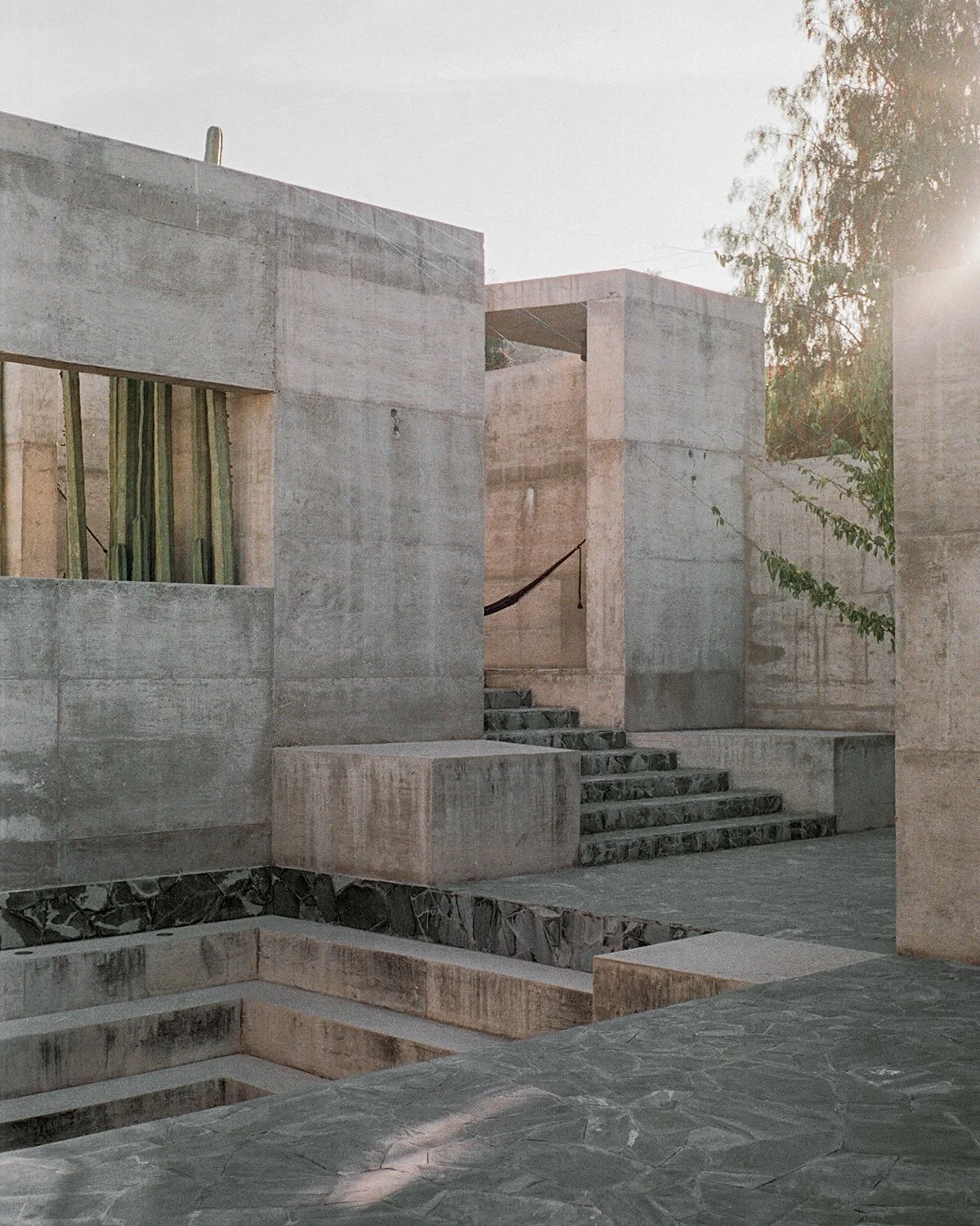
El resultado es de una audacia extraordinaria ya que, en muchos sentidos, tanto Emmanuel como Marcos, dejaron que la casa se expresase: “Hicimos un gran trabajo de paisajismo, sobre todo del casco viejo. Realmente [la casa] no tiene techos ni nada, sino que es como una abstracción manual. La parte de atrás del terreno estaba vacía porque eran las caballerizas y decidimos hacer esta locura. Traspasar este casco viejo, conservado con plantas y cactus creciendo en las paredes, es como entrar a otra dimensión. No sabes qué está pasando. De pronto, llegas a esta piscina con las vistas a un peñón gigante, el tercero más grande del mundo después de Gibraltar. Emmanuel logró hacer que te sientas en medio de la nada.”
La idea de Marcos siempre fue que la casa se convirtiera en un espacio lúdico para compartir con sus amigos y con su familia. “Mis sobrinos me la piden mucho para ir con sus amistades. Es una casa en la que realmente se consiguió lo que yo quería. Sabía que era un lugar hermoso que podía tener una nueva vida. Se logró y estoy muy contento con eso”.
Si bien la alberca se puede considerar la gran protagonista del espacio, todo el tratamiento dado al proyecto convierte a Casa Bernal en una obra para admirar, más allá de su habitabilidad. La pieza dialoga con el paisaje, lo acompaña, se nutre de él y juntos componen estampas que rezuman vida como una espléndida flor que se abre paso entre los escombros.
CASA BERNAL
A FLOWER AMIDST THE RUBBLE
-
Story about Casa Bernal for Openhouse magazine Nº20.
-
Written by Inma Buendia inmabuendia.com
Photographed by Luis Garvan luisgarvan.com
Chic by Accident chicbyaccident.com -
A FLOWER AMIDST THE RUBBLE
As if they were heroic deeds, history extols the actions of individuals who – despite adverse circumstances – find success during their lifetime. While society acknowledges their perseverance and strength, intuition – that mental state that allows our senses to pinpoint the moments when we must act and the opportunities we must not squander – is rarely mentioned.
Marcos Ruiz is one of those individuals with good instincts, delighting in the process of construction and self-construction. I meet with him at his home in Mexico City. Sparsely furnished, one can sense the meditated decision behind the few items found in the house. They all make a statement, have an extraordinary presence and are imbued with great character. We take our seats on the majestic sofa, where he begins relating the journey of his profession – past, present and future. I discern common features throughout: a refined aesthetic taste and a sincere interest both for the history of humanity and for the objects that have adorned it throughout time until the present day. “I believe that interior design is like collecting because it’s a form of expression. At the end of the day, you’re telling a story; it's a language in itself – albeit a very abstract language – but it serves to tell a story.”
Born and raised in Querétaro, Marcos has resided in Mexico City for more than fifteen years, although he has temporarily lived in other places. “When I moved here, I began acquainting myself with the city’s art galleries.” Little by little, he learned how to be a curator, a collector, acquiring the artistic eye that would lead him to construct his own creative universe. Despite coming from a different background, he has always admired architecture, design and art. “I’m fascinated by the creative process of bringing an idea to life. And I find interior design extremely exciting. It’s one of the things I most enjoy.” And so, when his family decided to rid themselves of the pile of rubble that Casa Bernal had become, Marcos decided to save it and restore it. A symbol of a key period in Mexico’s history, the house was once of great use to the local community: “It’s in a very small village where there was nowhere like the Bank of Mexico where you could take out or keep your money. All the mining companies in Huasteca Potosina used it as a stopover before going on to Mexico City and they'd keep everything inside the house, which operated as a sort of bank. But, after the revolution, it was looted and abandoned.”
In order to make the Casa Bernal project come true, Marcos turned to Emmanuel Picault and his architecture firm, Chic by Accident,. “It was a very motivating and enriching experience. He's got an impeccable eye and a stage design aesthetic that’s reflected in the house.” Marcos speaks from his own experience. Emmanuel had handed him the keys shortly before the pandemic hit. Mexico City was deserted, so he decided to move to Bernal temporarily. “We spent about four or five months there with just two mattresses. There’s nothing quite like enjoying a house by experiencing it. It’s a very small village, very beautiful but very quiet. I’d go out in the morning in my pyjamas to buy eggs and there was nothing. It was crazy.”
The result is extraordinarily bold because, in many ways, both Emmanuel and Marcos allowed the house to express itself. “We did a great job with the landscaping, particularly with the old outer shell. Actually, [the house] has no roof or anything; it’s like a really manual abstraction. The back of the plot – where the stables once were – was empty, so we decided to do this crazy thing. Entering this old shell, with plants and cacti growing alongside the walls, is like walking into another dimension. You don’t know what’s going on. Suddenly, you reach this pool with views of a giant rock, the third largest in the world after Gibraltar. Emmanuel has managed to make you feel as if you're in the middle of nowhere.”
Marcos’s idea was always to turn the house into a space to entertain family and friends. “My nephews and nieces are always asking me if they can bring their friends here. The house really has given me everything I wanted. I knew it was a beautiful place that could be given a new lease of life. That's been achieved, and I’m very happy with it.”
While the pool could be considered the true hero of the space, the way the entire project has evolved has made Casa Bernal a truly admirable creation, in addition to being incredibly liveable. The structure converses with the landscape, accompanies it, is nourished by it, and together they create a picture that radiates with life, like a splendid flower that subtly finds a way to bloom amidst the rubble.

EVERY FORM OF POETRY
GABRIEL ESCÁMEZ
SELECTED BY GABRIEL ESCÁMEZ
-
Photos by Clemente Vergara.
Words by me ;)
Cobalto Studio. -
Gabriel Escámez embodies everything one can attribute to a total artist. He possesses genius, sensitivity, charisma, overflowing energy, and great determination to achieve the desired outcome in each of his projects. When you are near someone with the tenacity and talent he possesses, their energy rubs off on you, which drives you to strive for excellence.
We find him at Cobalto Studio, the space that Gabriel and his team inhabit in Barcelona. A sort of art gallery, creative workshop, sensory archive, and office adorned with objects that are as emotive as they are beautiful. The entrance greets us with intriguing pieces of noble and pure materials. To the left, a long table is positioned in front of the glass facade, activating a dialogue between the interior and exterior. At the back of the studio, a resting area or small lounge leads to the more functional space. A wardrobe runs along the area of work tables. A hat, several drawings, photographs, ceramics, and other unique objects rest on top of it.
Gabriel shows us some of the items he has brought to add a personal touch to the article: the guitar that once belonged to his father, his unintended collection of white Vans sneakers, and some effects that are part of his particular creative universe. His enthusiasm for including them in the selection is more than noticeable. At the end of our visit, he decides that one of the 'artistic installations' he has arranged for the photos will be exhibited at Cobalto Studio for at least a few hours. "Could be fun, right?" he asks rhetorically in a question that summarizes all his persona at once.
After photographing the objects chosen for this 'Selected by,' we sit down to chat over a cup of coffee around the majestic table that welcomes Cobalto Studio’s visits. Relaxed, delighted by the soft winter sun streaming in through the windows, we converse about poetry, music, work and life in a brief but exquisite gathering.


Do you remember the first time you bought something with a collector's consciousness?
I don't think I've ever bought with the intention of collecting, just something I loved at that moment and wanted to have. There's something very romantic and poetic about how things age. It's not just the piece itself but its evolution. The study or appreciation of its aging process. There are nuances that can't be achieved otherwise.
What is the main characteristic that attracts you to an object?
I believe it's a matter of proportion. Volume is essential. Then also the story it may carry: the patina, the aging, and the materiality.
Have you always created spaces? Do you remember yourself, even as a child, doing so?
Yes, I made still lifes at four years old. It's something that came to me very naturally and it's healing because when I do it, the perception of time disappears, and I feel good.
How do you think the beauty of our surroundings influences our mood?
This journey we're on here, at least in my case, if it isn't surrounded by beauty, would probably lack meaning.
In your interior design projects, you seek to connect the space with the most primal aspect of the place. How do you go about that search?
First, you have to interpret the space, the location, and the many factors that influence it, to then be able to develop the space's own story. Fortunately, we have many clients who allow us to generate the storytelling from scratch and even want each space to have uniqueness. It's something that keeps me alert and prevents me from getting bored.
Regarding the selected objects for this article, tell us about the Vans. What attracts you to them? When and how did you decide to bring this collection to us?
Well, I think it happens to a lot of people. When you get used to a pair of shoes and you find it impossible to stop wearing them even in inappropriate moments. You're dressed in a tuxedo and suddenly you want to wear Vans because you can't see yourself with any other footwear even though I have other very interesting ones too. Thinking about how to bring the selection closer to the character, it occurred to me that this really defines me.
What can you tell us about your father's guitar that is part of the selection?
I brought it because I started again with lessons and wanted to play this specific guitar, but in the end, I decided to go back to the piano. It's always beautiful to have something from my father who is no longer here. It symbolizes him and is still part of his presence and his enthusiasm that accompanies me.
Is there any place that if you could collect, would be part of your particular 'Selected by'?
One of the spaces that has given me the most Stendhal syndrome has been the Maeght Foundation. I think it's the most barbaric and beautiful place I've ever been. I would love to live there. I like the materiality, the place, the vegetation, the art pieces... everything. I believe it's the epitome of everything I expect from life.
How was the design and search for the current Cobalto Studio?
I found this place with the idea of having a more comfortable space to centralize the warehouse and the studio. Now we are much more focused on art direction, set design, interior architecture, and projects that are more related to the essence of the studio. The cataloging of the space and everything related to the archive is only 3% of what we do today.
When and how was La Cobalta born?
It started parallel to Cobalto and emerged to discuss topics that were the soul of Cobalto, generating a language that appeals to the poetic, the cultural, and the wildness of the Mediterranean coast.
There is a lot of poetry in your life. It is very present in your way of explaining your work.
I love reading poetry but poetry isn't only written, you can find poetic elements in an act, in a light, in a photograph, in a person, in the way someone else speaks...
What projects excite you now?
Well, I'm very happy with projects that are to generate spaces but where storytelling is very much linked. It's much more fun because we can generate concepts linked to the overall image that don't just involve space. It's much richer, it's more sociocultural.
Music is also very present in Cobalto and in your personal life. What do you listen to the most?
What I listen to the most, and I think it also goes very much in line with what we have represented in the selection and representation of objects, is jazz. I love everything that was done in the early 20s of African music, but derived towards jazz. It's like a reinterpretation of cubism-brutalism. It's cubist, but taken to the African. If I had to summarize it in just one song, it would be the ‘Love Theme From Spartacus' by Yusef Lateef included in the Eastern Sounds album of 1961.
Six N. Five
MATERIALIDAD
Y
ABSTRACCIÓN
Ezequiel Pini e Isern Serra
MATERIALIDAD
Y
ABSTRACCIÓN
-
Item description
-
-
Art direction by Isern Serra and Openhouse Studio
Art direction assistance by Aasheen Mittal and Inma Buendía
@aasheenm
Photographed by Martina Matencio martinamatencio.com
Photography assistance by Xavi Garcia xavigarcia.work
Styling by Jaume Vidiella jaumevidiella.com
Styling assistance by Laia Tornil @lalabananaltg
Production by Lucía Palazzi @luciapalazziandreu
Model Shannon Cheung from Fifth Avenue Models 5thmodels.com
Make up & Hair by Bárbara Mattel deKasteel Artist Management @barbaramattel @kasteelartistmanagement.com
Six N. Five sixnfive.com
-
Para los nacidos en los años 80 y 90 (entre los que me encuentro), hay imágenes que marcaron en la niñez la idea de lo que serían las primeras décadas del siglo XXI. Películas como Regreso al Futuro y Blade Runner nos invitaron a soñar con nuestro presente, entonces un futuro que se percibía como muy lejano, cuando la era de los ordenadores domésticos y los móviles estaba en una fase inicial. Desconozco si la realidad ha superado la ficción, pero sí me atrevería a decir que quizá uno de los factores del éxito de Ezequiel Pini, sea el hecho de haber crecido digitalmente al mismo tiempo que lo hacía la tecnología. Su proyecto, Six N. Five, es una plataforma creativa que diseña mundos virtuales en los que retuerce el imaginario construido socialmente hasta crear un lugar nuevo que parte de la realidad humana, pero que intenta ir mucho más allá de esta.
Para Ezequiel, el 3D es una herramienta creativa y él un artista digital. “Siempre tuve interés por la parte artística y creativa, pero también tengo una parte tecnológica muy fuerte. En la escuela secundaria, en Argentina, elegí la especialidad de informática. Después entre las carreras universitarias disponibles, escogí estudiar diseño gráfico y, mientras, fui explorando distintos ámbitos como la programación web, la animación y el diseño por código. Hasta que en un momento encontré que utilizando el 3D como herramienta tenía más libertad para representar mis ideas de una manera realista”. Six N. Five comenzó en 2014, y unos años más tarde, justo después de mudarse a Barcelona, Ezequiel empezó a explorar su propio estilo, experimentando con paisajes y objetos con el 3D como punto de partida, hasta diseñar realidades no representativas ni descriptivas sino propias.


Cuando hubo de plantear el proyecto en términos formales a partir de un espacio físico, Ezequiel contactó con Isern Serra para diseñarlo. Este último llevaba un tiempo, al principio junto a Toni Arola y después en su propio estudio, dando respuesta a necesidades de una nada desdeñable cartera de clientes, cuando el diseño de su propia casa dió un giro a su carrera: “Cuando comienzas es más complejo mostrar lo que te gusta porque estás sujeto a lo que te piden. El proyecto de mi casa tuvo bastante repercusión, supuso un gran cambio en el estudio y así fue, también, como me conoció Ezequiel”.
El diálogo entre los dos a la hora de crear las oficinas de Six N. Five fue constante. Eso sí, con las fricciones propias entre la construcción digital y la real, lo que llevó a ambos a auto-cuestionar su modo de trabajo: “Ezequiel compone los espacios digitales como si fueran obras estáticas. No lo percibe tanto como un espacio real. Pero, en cambio, estéticamente estamos muy sincronizados porque nuestras referencias son muy parecidas. Tuve mucha libertad”. Para Ezequiel, el hecho de no poder visualizarlo digitalmente, supuso un pequeño desafío: “En un momento dado, yo necesitaba ver render porque todo mi proceso creativo es muy visual e instantáneo. Necesito verlo”.
“Ezequiel compone los espacios digitales como si fueran obras estáticas. No lo percibe tanto como un espacio real. Pero, en cambio, estéticamente estamos muy sincronizados porque nuestras referencias son muy parecidas. Tuve mucha libertad.”
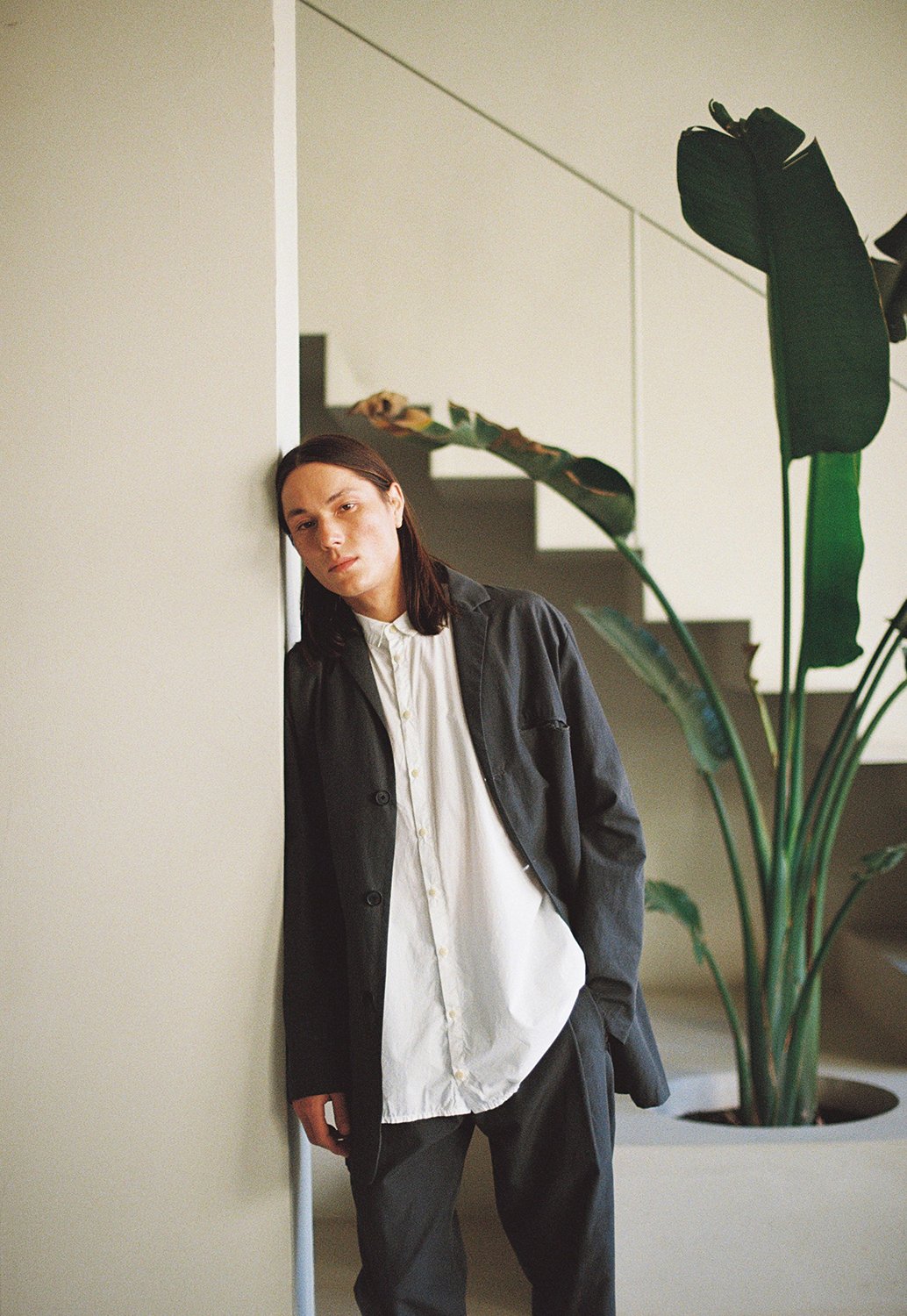
El resultado es fiel reflejo de las dos personalidades y representa un nuevo paradigma en el que lo digital ha pasado a influir en el trazo estilístico de los espacios físicos que habitamos. “Me gustaba la idea de un lugar de trabajo que fuese un poco casa también. Que fuera muy cálido porque al final pasamos muchísimas horas acá”, explica Ezequiel. La mesa, el sofá y la apertura de muros hacia la terraza son elementos que aparentemente no responden a los de una oficina.“La mesa es mínima, pero no es minimal, porque la desarrollamos desde la arquitectura. Tiene un peso y un valor, pero no contiene mucho detalle. Es casi brutal”, resume Isern, quien continúa reflexionando: “Con el tiempo, el diseño fue adoptando las actitudes y las maneras de trabajar de Ezequiel”. La fisionomía de Six N. Five responde a una serie de valores donde los elementos estáticos del interiorismo ayudan a que el proyecto se mantenga alejado de cierta tendencia de crecimiento que Ezequiel no percibe como algo necesariamente bueno. “La mesa principal de trabajo, si bien es grande, quería que tenga una cantidad muy limitada de posibles puestos de trabajo. Al ser estática y de concreto me obligaría a no seguir la tendencia de expansión, y de esta manera tener que tomar proyectos que quizás no quiera para mantener una estructura más grande. Expandirse supondría transformarse en un estudio de los clásicos, una máquina de hacer proyectos comisionados, y yo nunca me vi ahí. Me gusta más la idea de pequeño taller de arte, donde cada pieza se hace a medida”.
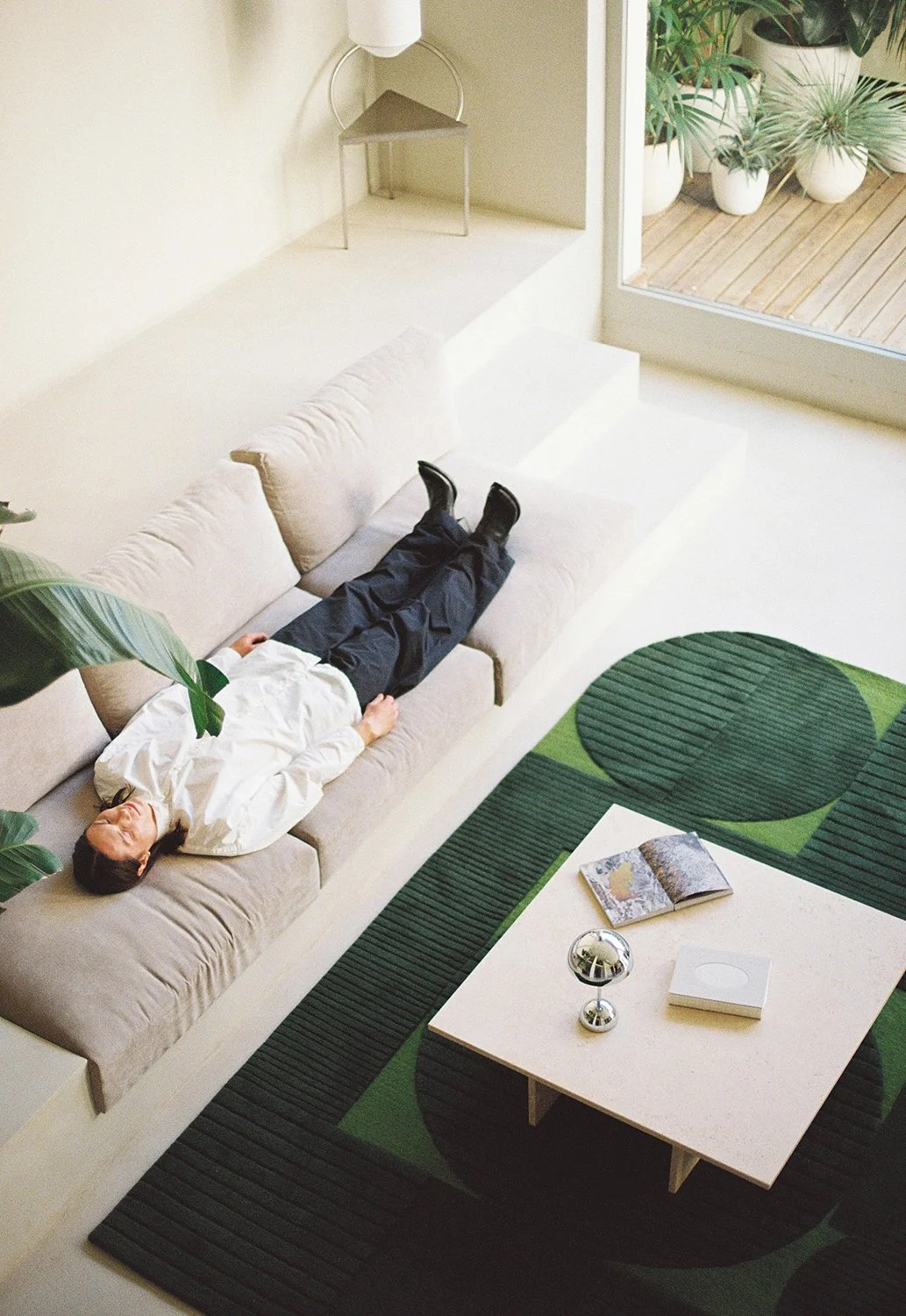
Abierto al público gracias a la incorporación de Three Marks Coffee, una tienda/cafetería que invita a refugiarse del ruido exterior y sentarse a degustar un buen café, la ‘casa’ de Six N. Five es fruto de un diálogo entre la materialidad y la abstracción. La interpretación empírica de un diseñador de interiores, Isern Serra, de un mundo creado por un artista digital, Ezequiel Pini, que no puede tocarse pero puede sentirse.
Six N. Five
MATERIALITY
&
ABSTRACTION
Ezequiel Pini & Isern Serra
MATERIALITY
&
ABSTRACTION
-
Written text about Six N. Five, the scenario for the editorial of the issue.
The editorial is the section of the magazine where Openhouse places pieces of contributor brands in a paradigmatic place.
-
-
Art direction by Isern Serra and Openhouse Studio isernserra.com
Art direction assistance by Aasheen Mittal and Inma Buendia
@aasheenmWritten by Inma Buendía inmabuendia.com
Photographed by Martina Matencio martinamatencio.com
Photography assistance by Xavi Garcia
xavigarcia.workStyling by Jaume Vidiella jaumevidiella.com
Styling assistance by Laia Tornil @lalabananaltg
Production by Lucía Palazzi @luciapalazziandreu
Model Shannon Cheung from Fifth Avenue Models 5thmodels.com
Make up & Hair by Bárbara Mattel deKasteel Artist Management @barbaramattel @kasteelartistmanagement.com
Six N. Five sixnfive.com
-
For those born in the 1980s and 90s (of which I am one), certain images from our childhood strongly imprinted our minds with an idea of what the first decades of the 21st century would look like. Films such as Back to the Future and Blade Runner invited us to dream of what is now our present, back then a future that was perceived as distant, and when the era of home computers and mobile phones was in its infancy. I don't know if reality has surpassed fiction, but I would venture to say that perhaps one of the factors behind Ezequiel Pini’s success is the fact that his growth in the digital world has mirrored that of technology. His project Six N. Five is a creative platform that designs virtual worlds in which he twists the socially constructed, collective imagination in order to create a new place that begins with human reality but with the intention of going far beyond it. To the point where there is no limit.
Ezequiel’s belief is that 3D is a creative tool and he a digital artist. “I’ve always been interested in the artistic and creative side, but I also have a very strong technological side. During my secondary education in Argentina, I chose to specialise in computer science. Then, of all the university courses available to me, I chose to study graphic design, while exploring such different fields as web programming, animation and designing in code. That was until I found that using 3D as a tool gave me more freedom to represent my ideas in a realistic way.” Ezequiel founded Six N. Five in 2014. A few years later, just after moving to Barcelona, he began to explore his own style, and he experimented with the 3D design of landscapes and objects as a starting point until he developed realities that were neither representative nor descriptive, but its own.
When a project required a formal design in terms of a physical space, Ezequiel contacted Isern Serra and entrusted it to him. The latter had been working for some time, initially with Toni Arola, and then at a studio of his own, catering to the needs of a not insignificant portfolio of clients. However, Isern’s career reached a turning point with the design of his own home: “When you start, it’s more difficult to show what you like because you’re bound by what you’re asked to do. The design of my own home had quite an impact; it brought about a big change in the studio, and it was also how Ezequiel got to know me.”
There was constant dialogue between the two on the project to design the Six N. Five offices. However, it also brought about friction between the digital rendering and real construction, which led them both to question themselves about their way of working: “Ezequiel lays out the digital spaces as if they were static works. Therefore, he doesn’t perceive space so much as a reality. But, on the other hand, we are very much in sync in terms of aesthetics because our references are very similar. I had a lot of freedom.” For Ezequiel, not being able to visualize the project digitally posed a small challenge: “At one point, I needed to see renderings because my whole creative process is very visual and spur of the moment. I need to see it.”
“Ezequiel lays out the digital spaces as if they were static works. Therefore, he doesn’t perceive space so much as a reality. But, on the other hand, we are very much in sync in terms of aesthetics because our references are very similar. I had a lot of freedom.”
The result is a true reflection of the two personalities and represents a new paradigm in which the digital has come to influence the stylistic outline of the physical, inhabited spaces. “I liked the idea of a workplace that also worked a bit like a home. I wanted it to be very warm because ultimately we spend so many hours here,” Ezequiel explains. The table, the sofa and the way the walls open out onto the terrace are features that apparently do not correspond to those of an office. “The table is minimalist, but it isn’t minimal, because we designed it from an architectural perspective. It has weight and value, but it doesn’t contain much detail. It’s almost brutalist,” Isern declares, adding: “Over time, the design gradually adopted Ezequiel’s mindset and ways of working". Six N. Five’s physical appearance responds to a series of values where the static elements of the interior design help the design to eschew a certain trend for expansion that Ezequiel does not necessarily perceive as a good thing. “For the main work table, while large, my intention was that it should have a very limited number of potential workstations. Being static and specific would force me not to follow the trend to expand, which would mean having to take on projects I may not want to take on in order to maintain a larger structure. Expanding would mean becoming a conventional design studio, a machine to churn out commissions, which I never envisioned myself to be. I like the idea of a small art workshop, where each piece is made to measure.”
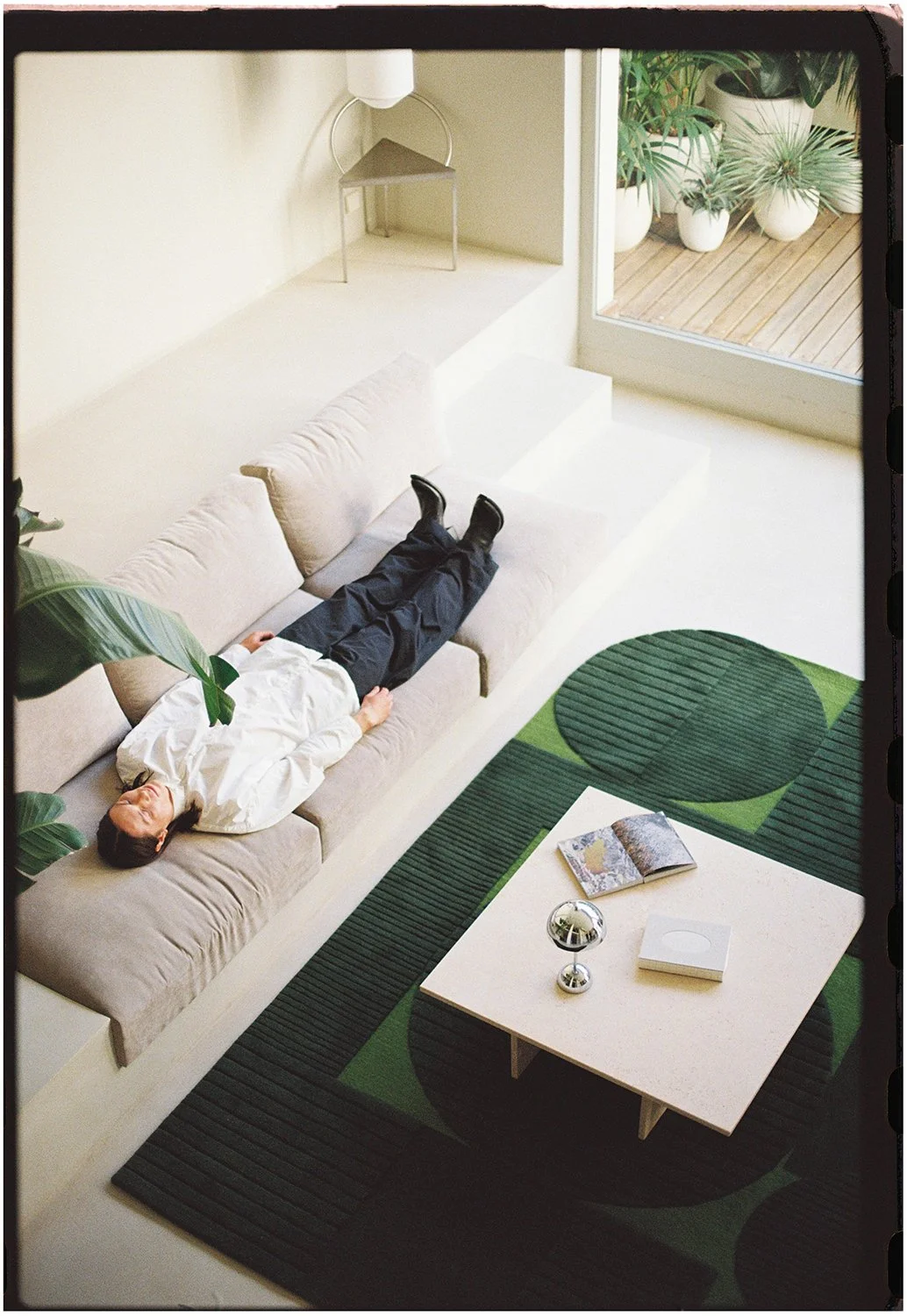
Open to the public thanks to the addition of Three Marks Coffee, a coffee shop and retail space that invites you to take refuge from the noise outside and sit down to a good cup of coffee, the ‘home’ that Six N. Five has become is the result of a dialogue between materiality and abstraction. It’s the empirical interpretation made by an interior designer, Isern Serra, of a world created by a digital artist, Ezequiel Pini, that cannot be touched, but it can be felt.