A revolution in the form of a work of art
ELVIRA SOLANA
ELVIRA SOLANA
-
Profile about artist Elvira Solana.
-
-
Photos by Victor Stonem
victorstonem.comElvira Solana
@elvirasolana -
After spending a sunny August morning with Elvira Solana, I feel like I've met a matryoshka, one of those Russian dolls that, when opened around the middle, reveal smaller figures inside. I approach her, attracted by the beauty of her forms, her embellishments and her colour without knowing that, inside her, there is so much more to be found.
During the hour and half that we sit and chat over a cup of tea on her sea-view terrace, she slowly reveals what is beyond the surface of her exquisite work. And, at the same time, I get to discover the layers to Elvira, who takes great care in explaining her work and with it, herself.
Opening the first one, she tells me that she actually studied architecture in Madrid but before long, thanks to several exchange programs, she began to travel: “I went to India, to Barcelona, then I spent some time in Paris and later went to Istanbul. I have always been attracted to the East. It held a certain intrigue for me and, in the end, it was very enlightening.”


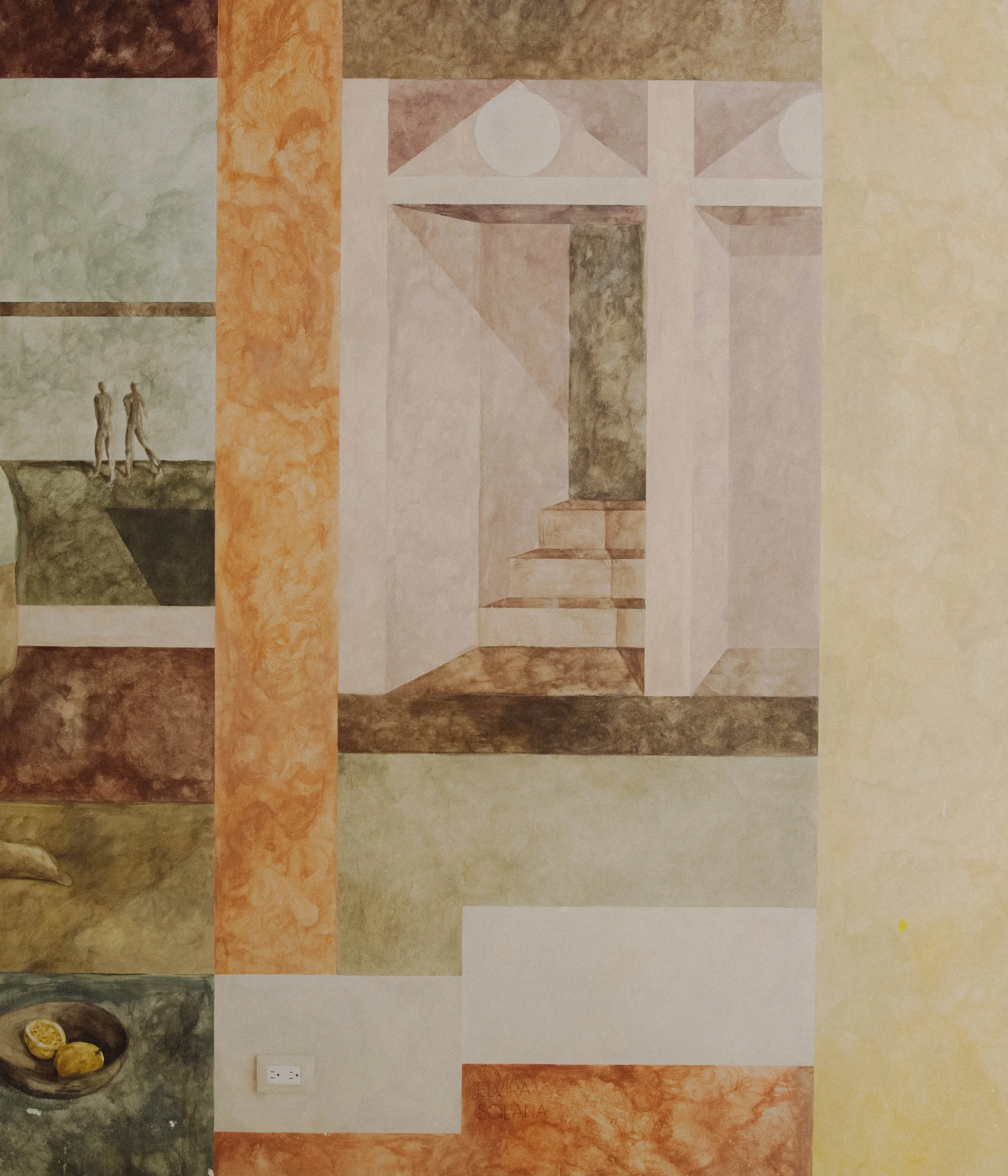
Her travels around the world were a great source of inspiration, giving rise to a creativity that she did not get from her university education: “The academic models we have now are good because they are very democratic, but they also somehow standardise everything. And this is what happened to me, that during the training process, I missed out on the manual aspect, a skill that I felt I could contribute.” This, together with her work in several architectural studios in the middle of the economic crisis, created an internal conflict within Elvira that led her to leave architecture behind. “I started painting and decided to try it for a year to see if it would take off. And it did. At first, I painted birds, plants, etc., but after a while I started to connect architecture and painting without even realising it.” After researching murals throughout history, Elvira began to understand that her training as an architect was not entirely unrelated to her approach to murals. “The first muralists in history were architects. I understood why I became curiously fascinated with combining these two aspects and why it wasn't so far from me and my profession.”
“My commitment to the indoor mural is based on researching the relationship that human beings have with space and privacy”
Following this enlightening realisation, Elvira took her brushes and a backpack and left Cantabria to return to Madrid in search of walls to work on. “You see, sometimes the planets align and that's what happened. I ran into a friend from university who had just bought a house: 'It's been closed for sixty years and we have to refurbish it, but you have six months to try out your work there,' he told me.” After five months of work, Elvira inaugurated ‘Real Estate’, convening several media outlets. She still remembers being full of nerves on the days leading up to it. She slept on a mattress in the middle of that empty house’s living room. “I didn't know if what I was doing was going to work or not. It was a miracle. There are many days when I remember that it was only three years ago. The flat turned out to be an incredible place measuring about 350m2, which I enlarged to 10,000m2. With ‘Real Estate’ I established the principles upon which I was going to base the rest of my career.”

“In murals, as in architecture, you need a first project for clients to trust you”, she explains to me. Her case makes perfect sense in theory, and I tell her that at Openhouse, we were amazed when we found out, through Instagram, about the mural that she had done in the house of a relative in Santo Domingo. And on the subject of privacy and social networks, Elvira opens up a new matryoshka. “My commitment to the indoor mural is based on researching the relationship that human beings have with space and privacy. I don't have WhatsApp, and I only have Instagram for work”, a practice that requires a certain break with the system, a lot of courage and a great deal of obstinacy. “We live surrounded by images that we compulsively consume. But the image expires and dies quickly if it is not supported by an idea. Ideas are the structure. They allow an image to remain in time without being immediately exhausted; this is the purpose of my work”.
A month after our meeting, I know that Elvira, a troubadour of mural architecture, may have had countless new revelations that she has captured in her mock-ups and in her many notebooks, her daily work tools. “These notebooks carry ideas that at some point will be turned into murals. They are ideas that allow me to keep moving forward.” In these times of endless accelerated consumption, meeting someone with an elaborated and meditated discourse like Elvira is a true breath of fresh air. “A mural is an overlapping of two languages: that of architecture, which is three-dimensional and volumetric and implies a movement around it; and that of painting, which is two-dimensional and has a frontal perception. I don't want to resolve the idea of continuity but to question all the conflicts about the perception of the human eye versus the scale of the place or its context.”
Opening the last matryoshka takes me to her studio, just a few metres from the flat where she is staying for the summer. There, she also uses an attic-like room as a canvas where she puts many of her ideas into practice. Few people, she confesses, have seen what is hidden at the top of the tower. When I set one last foot in this space of reverie, I feel that I am entering a new space not governed by the physical rules that apply outside it. Perhaps, I think, this is the true purpose behind Elvira Solana's work: the search for a room of our own that transforms our perspective, pulling us to dream of a new reality.
UNA REVOLUCIÓN EN FORMA DE OBRA DE ARTE
ELVIRA SOLANA
ELVIRA SOLANA
-
Perfil acerca de la muralista de arquitectura, Elvira Solana.
-
-
Fotos de Victor Stonem
victorstonem.comElvira Solana
@elvirasolana -
Después de pasar una soleada mañana de agosto con Elvira Solana, me siento como si me hubiera enfrentado a una matrioska. Una de esas muñecas rusas que, abiertas por la mitad, descubren figuras más pequeñas en su interior. Me acerco a ella atraída por la belleza de sus formas, por su ornamentación y por su color sin saber que dentro de ella hay mucho más.
Durante la hora y media que nos sentamos a charlar alrededor de una taza de té en su terraza con vistas al mar, ella misma va extrayendo las capas de madera, desvelando los estratos internos de su exquisito trabajo. Y al mismo tiempo, yo voy descubriendo las capas de la propia Elvira, que intenta con mucho atino explicar su obra y con ello, a sí misma.
Con la apertura de la primera, me cuenta que en realidad ella estudió arquitectura en Madrid aunque en seguida, gracias a varios programas de intercambio, comenzó a viajar: «Estuve en India, en Barcelona, luego pasé una temporada en París y después me fui a Estambul. Siempre he tenido atracción hacia oriente. Tenía cierta curiosidad y fue bastante revelador en realidad».
“Mi apuesta por el mural en interior se basa en la investigación de la relación del ser humano con el espacio y con la privacidad”
Su periplo por el mundo supuso una gran fuente de inspiración; una creatividad que, sin embargo, no le llegó por parte de la formación universitaria: «Los modelos académicos que tenemos ahora están bien porque son muy democráticos pero de alguna manera uniformizan. Y esto es lo que me ocurrió a mí, que en el proceso de formación perdí la parte manual, esa capacidad que es la que yo podía aportar». Algo que, junto a su trabajo en varios estudios de arquitectura en plena crisis económica, creó en Elvira un pequeño conflicto personal que desembocó en una ruptura con la arquitectura. «Empecé a pintar y decidí probar un año para ver si arrancaba. Y arrancó. Al principio pintaba pájaros, plantas… pero después de un tiempo empecé a conectar arquitectura y pintura sin apenas darme cuenta». Tras documentarse sobre el mural a lo largo de la historia, Elvira empezó a comprender que su formación como arquitecta no estaba lejos de su manera de enfrentarse al mural. «Los primeros muralistas de la historia fueron arquitectos. Entendí cuál era el hilo del que estaba tirando y por qué no estaba tan lejos de mí y de mi profesión».
Aquello fue tan revelador que Elvira cogió sus pinceles, una mochila y dejó Cantabria para volver a Madrid en busca de paredes sobre las que trabajar. «Mira, a veces se alinean los planetas y eso es lo que ocurrió. Me encontré con un amigo de la facultad que acababa de comprarse una casa: ‘Lleva cerrada sesenta años y tenemos que reformarla, pero hasta dentro de seis meses tienes tiempo para hacer allí tus pruebas’, me dijo. Después de cinco meses de trabajo, Elvira inauguró ‘Real Estate’, convocando a varios medios de comunicación. Los días previos aún los recuerda llenos de nervios. Dormía en un colchón en medio del salón de aquella casa vacía. «No sabía si lo que estaba haciendo iba a funcionar o no. Fue un milagro. Hay muchos días que pienso que hace sólo tres años de esto. El piso resultó ser un lugar increíble de unos 350m2 que con mi intervención amplié en 10.000m2. Con ‘Real Estate’ establecí los principios sobre los que iba a cimentar el resto de mi carrera».
«En el mural, como en la arquitectura, necesitas un primer proyecto para que los clientes confíen en tí», me explica. Su caso encaja a la perfección en la teoría, aunque en Openhouse nos quedamos maravillados cuando conocimos, a través de Instagram, el mural que hizo en la casa de un familiar en Santo Domingo, le digo. Y a colación de la privacidad y de las redes sociales, Elvira abre una nueva matrioska. «Mi apuesta por el mural en interior se basa en la investigación de la relación del ser humano con el espacio y con la privacidad. No tengo WhatsApp, y tengo Instagram sólo por trabajo». Un ejercicio para el que es necesario cierta ruptura con el sistema, mucho arrojo y una gran obstinación. «Vivimos rodeados de imágenes que consumimos compulsivamente. La imagen caduca y muere rápido si no está respaldada por una idea. Las ideas son la estructura. Éstas permiten que una imagen pueda permanecer en el tiempo sin agotarse inmediatamente y esa es la finalidad de mi trabajo».
Un mes después de nuestro encuentro, sé que Elvira puede haber tenido un sinfín de nuevas revelaciones que esta trovadora de la arquitectura en forma de mural, haya plasmado en sus maquetas y en sus múltiples cuadernos, sus herramientas de trabajo diario. «Estos cuadernos tienen ideas que en algún momento se traducirán en murales y que me permiten avanzar. En estos tiempos de consumo acelerado, enfrentarse a alguien con un discurso elaborado y meditado como Elvira es un verdadero hallazgo. «Un mural es una superposición de dos lenguajes: el de la arquitectura, que es tridimensional y volumétrico e implica un movimiento a su alrededor; y el de la pintura, que es bidimensional y tiene una percepción frontal. Yo no quiero resolver la idea de continuidad sino cuestionarme todos estos conflictos sobre la percepción del ojo humano frente a la escala del lugar o contexto».
La apertura de la última matrioska me lleva a su estudio a escasos metros del piso en el que está residiendo durante el verano. Allí además cuenta con un lienzo en forma de habitación semi abuhardillada donde pone en práctica muchas de sus ideas. Pocas personas, confiesa, han visto lo que se esconde en lo alto de esta torre. Cuando pongo un último pie en este espacio de ensoñación siento que me adentro en un nuevo lugar que no se rige por las reglas físicas del exterior. Quizá, pienso, sea éste el verdadero propósito que se esconde tras el trabajo de Elvira Solana: la búsqueda de una habitación propia que transforme nuestra perspectiva llevándonos a soñar con una nueva realidad.
HAUSER & WIRTH MENORCA
AN ISLAND
WITHIN
AN ISLAND
AN ISLAND
WITHIN
AN ISLAND
-
Story about Hauser & Wirth Menorca based on a visit about two months before the opening.
-
-
Photos by Salva López
salvalopez.comHauser & Wirth Menorca
menorca.hauserwirth.com -
In the autumn, when you read this article, little or nothing new will remain to be said about the cultural centre and gallery Hauser & Wirth opened this summer in Menorca. But I'm actually visiting it more than a month before it opens. The exhibition spaces are empty, and in the Cantina, the finishing touches are being added to welcome all those who want to take shelter from the sun and gather their strength in a summer with temperatures that will reach record highs.


It's 8 June 2021, forty days before the centre is to open. My welcoming committee is not the couple for whom the renowned Swiss gallery is named, but rather a new family created in this cosy space in the heart of the Isla del Rey: Luis Laplace, the architect behind the project; Mar Rescalvo Pons, the centre's director; and Marta Coll, head of press and communication. Marta picks me up at the port in Mahón and explains the history of this unique strategic enclave as we sail the waters of the port. She tells me that in 1711, during the period of English rule, Admiral John Jennings ordered a naval hospital be built here so that those wounded in any future conflicts would not have to be taken inland on Menorca. The hospital is still a living part of the island, and the non-profit foundation created to preserve it, 'Els Amics de l'Illa de l'Hospital' (Friends of Hospital Island), is working to restore the central building. Hauser & Wirth is not involved with the work on this building, but rather with an industrial storage complex that was added to the front of the building in 1784 to house the hospital's medical supplies.
We finally land on the Isla del Rey, and under the blazing sun, we meet Luis and Mar. The three members of the team are buzzing with nerves and excitement about explaining the project. The rapport between them is obvious. They finish each other's sentences, joke with each other, and radiate a natural ease that makes me feel almost immediately at home.
The first stop on our tour is in the main courtyard, whose wall splits in the centre to form a perfect square that opens to the outside. “We wanted to highlight the fig tree, as this is the biggest opening in the whole project,” explains Luis. In the cosy little space that serves as the entrance to the gallery, we are greeted by a Louise Bourgeois spider. The midday sun plays with the piece, tracing the insect's body in shadow on the floor and making it crawl up the walls as the hours go by.
“For me, the most interesting challenge was discovering the place, understanding its personality. It’s loaded with history, and that should be showcased rather than denied”
As we tour the different spaces that make up the centre, Luis explains to me that a decade ago, Manuela Hauser and Iwan Wirth - with whom he was visiting the island - discovered the building hidden under weeds, almost completely buried by the passage of time. “The most incredible thing is that you couldn’t see it from the sea. It was completely overgrown. The roofs were in very poor condition. It was a bit of a rogue building that no one had realised was there”, explains Luis. The restoration of the structure was carried out with great care, preserving as many of the original beams and other materials as possible. “For me, the most interesting challenge was discovering the place, understanding its personality. It's loaded with history, and that should be showcased rather than denied”. Being in contact with and nurturing the local community is an essential part of the Hauser & Wirth centre. “Although we have a contemporary art exhibition in the gallery, the rest of the work is focused on joining forces with existing quality cultural projects on the island, creating synergies and increasing what we have to offer”, says Mar.
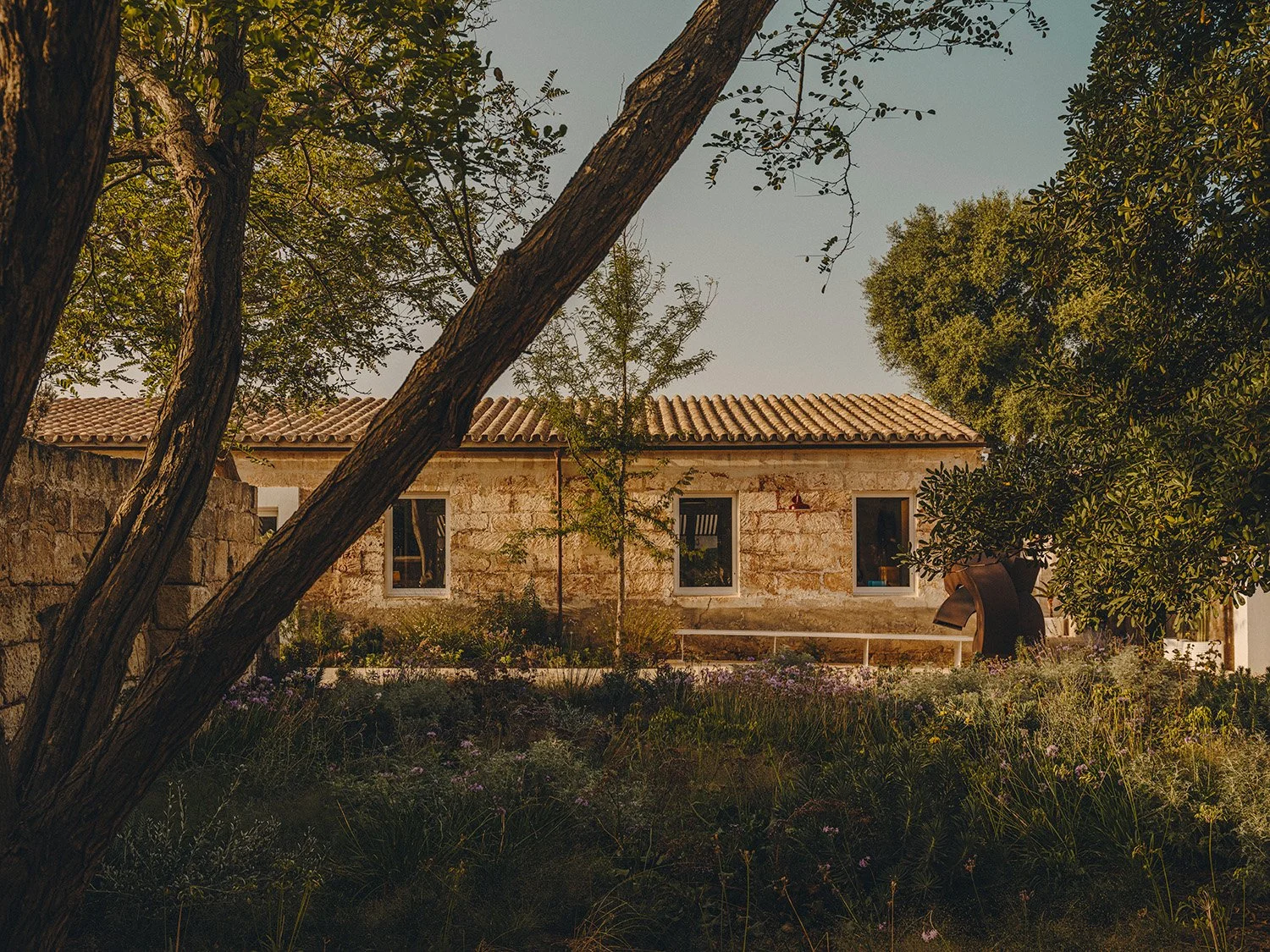
But the project doesn't end there. The surroundings form part of a dialogue between art and nature that is so typical of the Hauser & Wirth gallery. We stroll among the works by Franz West, Miró and Chillida that inhabit the garden designed by the acclaimed Piet Oudolf. “Piet did a huge job of cleaning up, preserving the local flora and stripping away the rest because, as it happens, the landscape was hidden under several metres of cane and bamboo", says Luis. Over the years, the two have forged a relationship of friendship and mutual respect: "Piet has one thing that I love, and that's that he talks about his garden as being in a state of rest when winter comes. He talks about the death of something and of the beauty hidden in that same time. The end of a season can be a form of movement”.
The breeze rustling through the branches of the olive trees highlights the Mediterranean landscape while gently wearing away at the building and breathing ever more life into its structure. “As a non-architect, one thing that fascinates me about the project is that it manages to make you feel, at all times, the immediate presence of the space that you're in. The island is a beauty in itself, so the landscape you see framed in the windows becomes a work of art”, Mar says.
The three confess to being in love with the humblest of the Balearic Islands, a devotion they share with Iwan and Manuela, who come to Menorca every summer. Marta and Mar were born here. Luis, an Argentinian based in Paris, thinks of himself as a proud adopted son of Alayor, the Menorcan village where he has his second home. Now the three of them have put down roots in this small Isla del Rey, whose imposing past opens a new chapter in history towards a promising future.

HAUSER & WIRTH MENORCA
UNA ISLA
DENTRO
DE OTRA ISLA
UNA ISLAND
DENTRO
DE OTRA ISLA
-
Reportaje sobre Hauser & Wirth Menorca a dos meses de su apertura oficial en verano de 2021.
-
-
Fotos de Salva López
salvalopez.comHauser & Wirth Menorca
menorca.hauserwirth.com -
En otoño, cuando se publique este artículo, poco o nada nuevo se podrá decir del centro cultural y galería que Hauser & Wirth ha abierto este verano en Menorca. Pero lo cierto es que yo lo visito cuando aún falta más de un mes para su apertura, los espacios expositivos están vacíos y en la Cantina se ultiman los detalles para acoger a todo aquel que quiera resguardarse del sol y tomar fuerzas en un verano en el que las temperaturas alcanzarán máximos históricos.
Es 8 de junio de 2021, quedan cuarenta días para la inauguración del centro y para recibirme no está el matrimonio que da nombre a la reconocida galería suiza sino una nueva familia creada en torno a este acogedor espacio en plena Isla del Rey: Luis Laplace, el arquitecto que firma el proyecto; Mar Rescalvo Pons, directora del centro y Marta Coll, responsable de prensa y comunicación. Esta última es quien me recoge en el puerto de Mahón y, mientras surcamos las aguas del puerto, me explica la historia de este singular enclave estratégico. Al parecer, en 1711 y bajo dominio inglés, el almirante John Jennings ordenó construir un hospital naval con la intención de atender a los heridos de posibles contiendas sin tener que adentrarse en el interior de Menorca. Dicho hospital continúa siendo parte viva de la isla y una fundación sin ánimo de lucro creada para su conservación, ‘Els Amics de l’Illa de l’Hospital’ [Los Amigos de la Isla del Hospital], trabaja en la restauración del edificio central. La intervención de Hauser & Wirth no se realiza en dicho edificio sino en un conjunto industrial destinado a almacenaje que fue incorporado frente a él en 1784 para guardar material sanitario que abasteciese al centro hospitalario.
A nuestra llegada a Isla del Rey y bajo un sol de justicia, nos encontramos con Luis y Mar. Los nervios y la ilusión por explicar el proyecto se perciben en los tres miembros del equipo. La química entre ellos es evidente. Unos acaban las frases de los otros, bromean y destilan una naturalidad que me lleva a sentirme, casi de inmediato, como en mi propia casa.
La primera parada de la visita es en el patio principal, cuyo muro se quiebra en el centro formando un cuadrado perfecto que se abre al exterior: «Queríamos poner en valor la higuera ya que ésta es la abertura más grande de todo el proyecto» explica Luis. Para recibirnos en este íntimo rincón que funciona como entrada a la galería, se encuentra la araña de Louise Bourgeois que, en diálogo con la luz del mediodía refleja la anatomía del insecto sobre el suelo haciéndola trepar por sus muros según van pasando las horas.
“Para mí, el desafío más interesante fue descubrir el lugar. Entender su personalidad. Hay un bagaje cultural que no hay que negar sino poner en valor”
Mientras recorremos los diferentes espacios que componen el centro, Luis me explica que fue hace una década cuando, bajo malas hierbas y casi completamente cubierto por el paso del tiempo, Manuela Hauser e Iwan Wirth, junto a quienes se encontraba visitando la isla, descubrieron el edificio. «Lo más increíble es que desde el mar no se veía. Estaba totalmente anegado. Los techos se encontraban en muy mal estado. Era un edificio un poco bastardo cuya existencia había pasado inadvertida», explica Luis. El trabajo de restauración realizado sobre la estructura se llevó a cabo con sumo cuidado, conservando todo lo posible vigas y otros materiales originales. «Para mí, el desafío más interesante fue descubrir el lugar. Entender su personalidad. Hay un bagaje cultural que no hay que negar sino poner en valor».
Para el centro Hauser & Wirth, estar en contacto y nutrir la comunidad local es un aspecto esencial. «Aunque tenemos una exposición de arte contemporáneo en la galería, el resto del trabajo se centra en unir fuerzas con proyectos culturales de calidad ya existentes en la isla, creando sinergias y aumentando la oferta», señala Mar.
Pero el proyecto no acaba ahí sino que el entorno forma parte del diálogo entre arte y naturaleza tan habitual de la galería Hauser & Wirth. Paseamos entre las obras de Franz West, Miró y Chillida que habitan el jardín del aclamado Piet Oudolf. «Piet hizo un trabajo enorme de limpieza, conservando la flora local y desechando lo demás porque, de hecho, había una capa de varios metros de caña y de bambú que ocultaba el paisaje» señala Luis. Con los años, ambos han forjado una relación de amistad y admiración mutua: «Piet tiene una cosa que me encanta, y es que habla de su jardín como en un estado de reposo cuando llega el invierno. Él habla de la muerte de algo y de la belleza que esconde ese mismo período. El fin de una estación puede ser una forma de movimiento».
La brisa que susurra entre las ramas de los olivos refuerza el paisaje mediterráneo al tiempo que erosiona dulcemente el edificio y mantiene su anatomía cada vez más viva. «Como no-arquitecta, una cosa que me fascina del proyecto es que ha conseguido que los espacios te sitúen en todo momento en el lugar en el que estás. La isla es bella en sí misma, por lo que el paisaje enmarcado en las ventanas se convierte en una obra de arte», señala Mar. Los tres se confiesan enamorados de la más humilde de las Islas Baleares. Una devoción que comparten con Iwan y Manuela, quienes residen en Menorca cada verano. Marta y Mar nacieron aquí. Luis, de origen argentino afincado en París, se considera un orgulloso hijo adoptivo de Alayor, el pueblo menorquín en el que tiene su segunda residencia. Ahora los tres han echado raíces en esta pequeña Isla del Rey, que con un imponente pasado, abre un nuevo capítulo en la historia hacia un prometedor futuro.